 English

 Slovak
 Czech
Czech
 Hungarian
 Italian
 Polish
 Slovenian





The iPhone 17e opens Apple Intelligence to a broader market
Apple took the first step in February 2025 with the iPhone 16e, which came with the A18 chip, its own C1 modem, and a starting price of $599, and was already built for Apple Intelligence at that time. A year later, the iPhone 17e followed suit, starting at the same $599 price point but increasing the base storage to 256 GB and featuring the newer A19 chip, C1X modem, and MagSafe, thereby bringing the AI-capable iPhone closer to a mass audience without raising the entry price. The hardware upgrade is also significant. Apple states that the C1X in the iPhone 17e is up to twice as fast as the C1 in the iPhone 16e and consumes 30% less power than the modem in the iPhone 16 Pro, while fast charging brings the battery to 50% in about 30 minutes and wireless charging goes up to 15 W. In other words, the "e" line is no longer just a cheaper iPhone, but a full-fledged entry point into the Apple Intelligence ecosystem.1[3]
The push for AI built right into the system
Apple Intelligence today is not a single standalone AI feature, but a layer woven throughout the entire system. Features already include Live Translation, visual intelligence for on-screen content, smart actions in Shortcuts, extensions for Genmoji and Image Playground, automatic suggestions in Reminders, and summarization and content handling across apps. Importantly, these features aren’t separate from the system but are integrated directly into messaging, calling, text editing, the calendar, photos, and automations—that is, into the activities users perform every day.[4]
Apple and Google have entered into a multi-year agreement under which the redesigned Siri and other future Apple Intelligence features will utilize Gemini models, while Google stated in a joint announcement that its technology will form the foundation for the next generation of Apple Foundation Models. Additionally, Apple Intelligence will continue to run on Apple devices and via Private Cloud Compute.[5]
Apple Silicon Delivers Performance, Privacy, and Cost Efficiency
The tech giant’s strength in AI lies not only in software but in the fact that the company controls the hardware, modem, operating system, and part of the cloud layer. The iPhone 16e uses the A18, whose 6-core CPU is, according to Apple, up to 80% faster than the A13 Bionic in the iPhone 11, and the 16-core Neural Engine handles machine learning models up to 6x faster than the A13. The iPhone 17e is already switching to the 3-nm A19 chip, featuring a 6-core CPU, a 4-core GPU, and an updated 16-core Neural Engine optimized for large generative models.13
From a financial perspective, it is also significant that the company performs a large portion of AI computations directly on the device and uses Private Cloud Compute on its own Apple Silicon servers for more demanding tasks; the company asserts that user data is neither stored nor shared with Apple under this model. This approach helps mitigate pressure on external cloud costs while supporting high profitability, with Apple achieving a gross margin of 48.2% in the latest quarter.[6]
For shareholders, the key question is whether AI will accelerate sales and sustain capital returns
Apple’s latest official quarterly report from January 29, 2026, shows that the company entered 2026 in very strong shape. Revenue reached $143.8 billion, representing year-over-year growth of 16%; diluted earnings per share rose 19% to $2.84; and operating cash flow reached nearly $54 billion. Apple also returned nearly $32 billion to shareholders in the same quarter.2
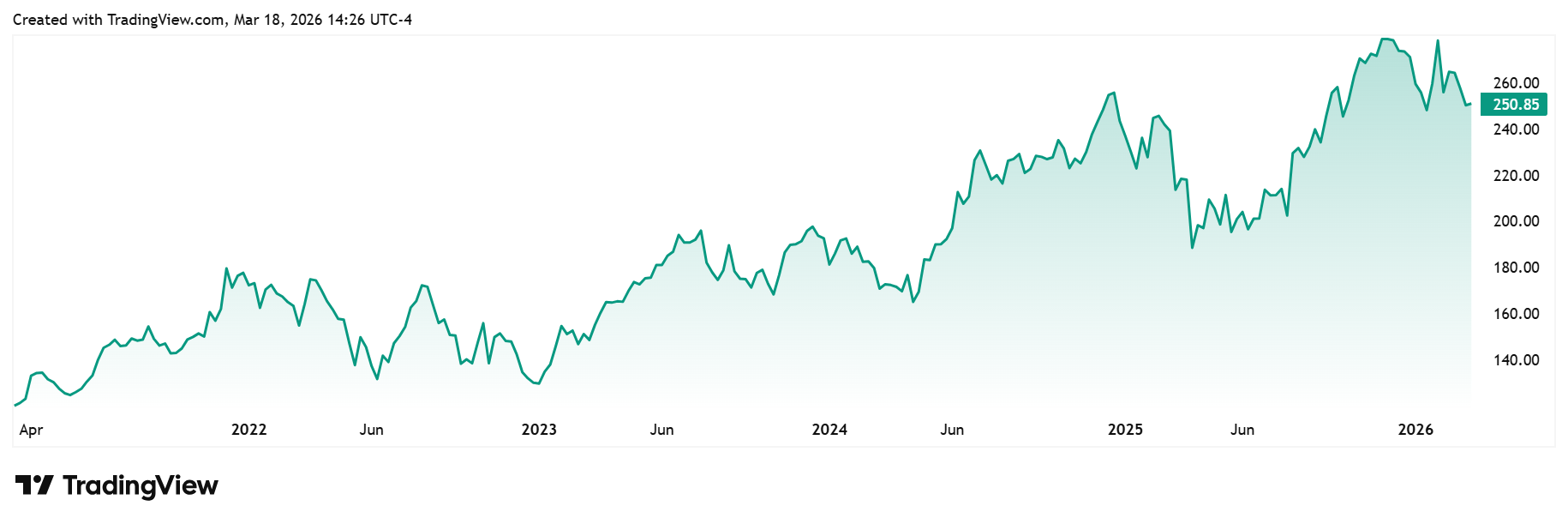
Apple’s stock price performance over the past five years*
The report further indicates that of this amount, $25 billion went toward the repurchase of 93 million shares and $3.9 billion toward dividends. The company also declared a quarterly dividend of $0.26 per share on January 29, 2026, and the dividend history confirms that the $0.26 rate was already in effect for declarations in May, July, and October 2025 and continued into January 2026.* For shareholders, this means only one thing. If Apple Intelligence helps accelerate the iPhone upgrade cycle and sustain services growth, the company still has ample room to continue dividends and buybacks at its current cash flow level.6 [1]
[1] Forward-looking statements represent assumptions and current expectations that may not be accurate or are based on the current economic environment, which may change. These statements do not guarantee future performance. By their nature, forward-looking statements involve risk and uncertainty because they relate to future events and circumstances that cannot be predicted, and actual developments and results may differ materially from those expressed or implied in any forward-looking statements.
* Past performance is no guarantee of future returns .
Warning! This marketing material is not and should not be construed as investment advice. Past performance is no guarantee of future returns. Investing in foreign currencies may affect returns due to fluctuations. All securities transactions may result in both gains and losses. Forward-looking statements represent assumptions and current expectations that may not be accurate or are based on the current economic environment, which may change. These statements do not guarantee future performance. InvestingFox is a trademark of CAPITAL MARKETS, o.c.p., a.s., regulated by the National Bank of Slovakia.
[1] https://www.apple.com/sk/newsroom/2026/03/apple-introduces-iphone-17e/
[2] https://www.apple.com/newsroom/2026/01/apple-reports-first-quarter-results/
[3] https://www.apple.com/sk/newsroom/2025/02/apple-debuts-iphone-16e-a-powerful-new-member-of-the-iphone-16-family/
[4] https://www.apple.com/newsroom/2025/09/new-apple-intelligence-features-are-available-today/
[5] https://www.reuters.com/business/google-apple-enter-into-multi-year-ai-deal-gemini-models-2026-01-12/
[6] https://www.stocktitan.net/sec-filings/AAPL/10-q-apple-inc-quarterly-earnings-report-d498ae47d743.html