 English

 Slovak
 Czech
Czech
 Hungarian
 Italian
 Polish
 Slovenian





A More Affordable Path to Weight Loss
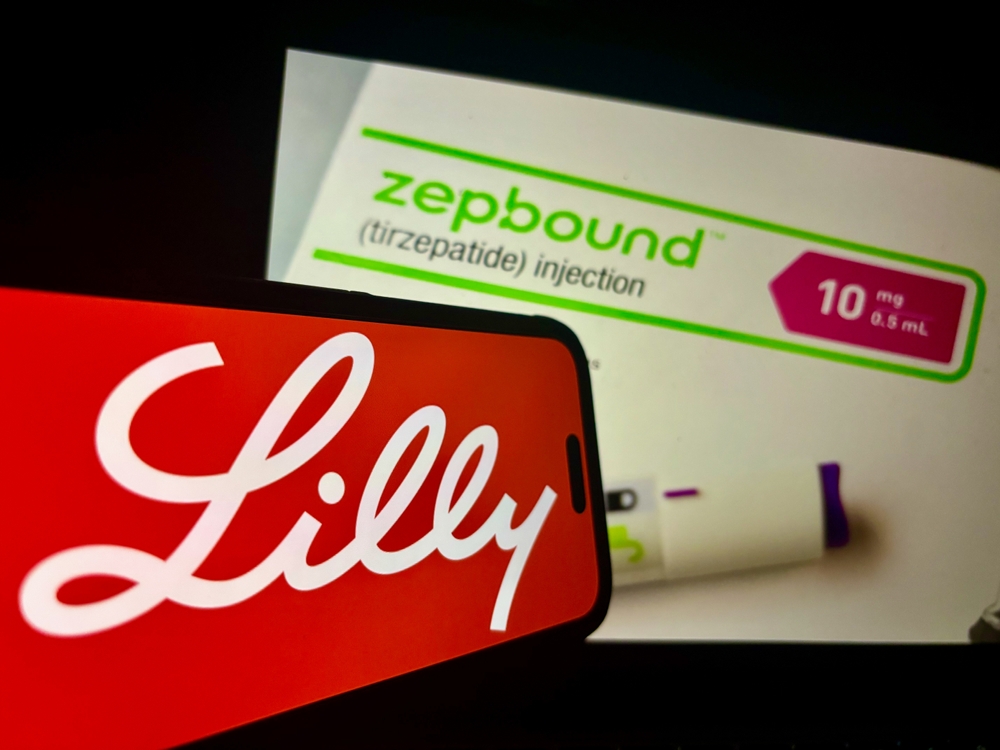
Eli Lilly has taken an important step in making Zepbound more accessible by reducing the price of lower-dose vials. The company announced that vials containing the lowest doses, 2.5 mg and 5 mg, will be $50 cheaper than their original price. This initiative aims to support uninsured individuals, including Medicare beneficiaries, by making the treatment more affordable. At the same time, Eli Lilly has introduced higher-dose vials (7.5 mg and 10 mg), priced at around $500, which is significantly lower than standard auto-injector pens that cost approximately $1,000. Although these injectable vials require patients to manually draw the medication into a syringe, their production is simpler than that of injection pens, allowing Eli Lilly to manufacture larger quantities and better meet growing demand. The American Obesity Coalition welcomed this progress, while Patrick Jonsson, President of Eli Lilly’s Cardiometabolic Health division, stated in an official announcement that the change is necessary. He emphasized that the company is committed to working with the government to improve access and will continue to provide new options for self-paying patients.
A Return to the Original
Eli Lilly’s actions also serve as a strategy to draw patients away from competitors and, more importantly, from compounded versions of weight-loss drugs. In recent months, these alternatives have gained popularity due to shortages of Zepbound and Novo Nordisk’s Wegovy. As a result, patients turned to pharmacies that provided customized and cheaper versions of these medications. However, on February 21, 2025, the U.S. Food and Drug Administration (FDA) officially announced that the shortage had ended, meaning that the production of many compounded alternatives will no longer be permitted. By offering lower-priced versions, Eli Lilly ensures not only wider accessibility but also access to safe and effective treatments, which unregulated alternatives may not provide. A key part of this strategy is LillyDirect, a direct-to-consumer website that enables patients to purchase vials through an independent pharmacy service.
Shares strengthened
The announcement also benefited Eli Lilly’s stock on the New York Stock Exchange (NYSE), which rose more than 3% on February 25, 2025. While some gains were later trimmed, the stock closed at $901.80, maintaining a multi-month high. Over the past year, Eli Lilly shares have increased by 15%, and the company reached an all-time high of $960 in August 2024, although the stock remains 6% below that peak. Over the last five years, the company’s stock price has surged by 550%, reflecting strong growth.*
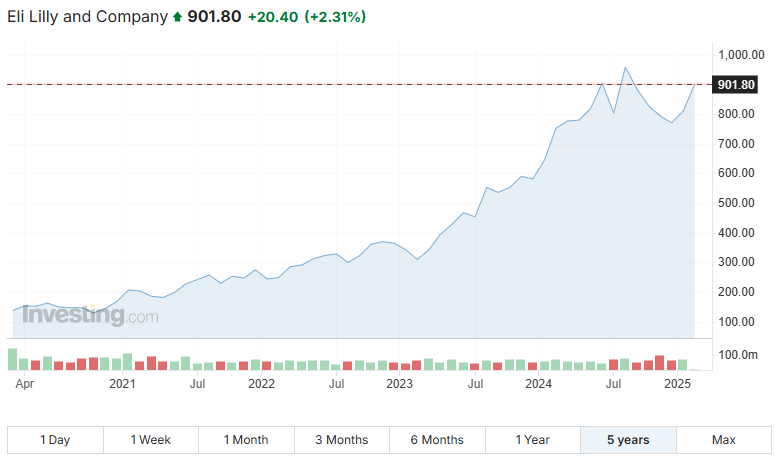
Source: Investing.com*
Millions Invested in a Weight-Loss Pill
Weight-loss treatment remains one of Eli Lilly’s core products, and the company has allocated another $550 million to develop an oral version of the drug. This new formulation is currently in testing, and the early-stage investment suggests the company anticipates high demand and wants to be prepared ahead of competitors like Novo Nordisk, which is also working on a weight-loss pill. According to experts cited by Reuters, this early investment could lead to multi-billion-dollar revenues in the future. The massive success of Zepbound has provided Eli Lilly with funds to invest in other critical areas, such as Alzheimer’s disease, heart disease, and even hearing restoration treatments. Dan Skovronsky, Eli Lilly’s Chief Scientific Officer, told CNBC that with this success comes a responsibility to use resources to tackle some of the biggest global health challenges.
Financial Results
Eli Lilly's fourth-quarter 2024 results, which were released on February 6, 2025, highlighted the growing dominance of Zepbound, with sales of nearly $2 billion. Although sales fell slightly short of expectations, it has become a leader in the obesity treatment market, according to its CFO, Lucas Mantarce. The lack of demand has forced Eli to invest heavily in increasing production capacity, which it expects will result in 1.6 times more doses produced compared to 2024. Total revenue reached $13.53 billion, up 45% year-on-year, while earnings per share reached $5.32.* Net profit rose to $4.41 billion from $2.19 billion in the previous year. Eli Lilly forecasts sales in the range of $58 billion to $61 billion this year with earnings per share of $22.05 to $23.55. The company expects continued demand for its drugs, with plans to expand Mounjaro into new international markets, which will further boost growth.[1]
Conclusion
Eli Lilly's decision to offer cheaper variants of Zepbound is a clear signal that the company wants to maintain its leadership position in the pharmaceutical market for the long term. The strategic move can not only increase the accessibility of treatments for patients, but also bring steady revenue growth to the company in the years to come. The strong demand for weight loss drugs, coupled with the expansion of manufacturing capacity and innovations in the form of oral alternatives, suggest that Eli Lilly still has room to grow. However, risks remain as regulations continue to evolve. Not to be forgotten is the increasing competition, which is also bringing many innovations.[2]
* Historical data is not a guarantee of future performance.
[1], [2] Forward-looking statements represent assumptions and current expectations that may not be accurate or are based on current economic conditions that may change. These statements are not guarantees of future performance. Forward-looking statements by their nature involve risk and uncertainty because they relate to future events and circumstances that cannot be predicted and actual developments and results may differ materially from those expressed or implied by any forward-looking statements.
Caution! This marketing material is not and should not be construed as investment advice. Historical data is not a guarantee of future performance. Investing in foreign currencies may affect returns due to fluctuations. All securities transactions may result in both profits and losses. Forward-looking statements represent assumptions and current expectations that may not be accurate or are based on current economic conditions that may change. These statements are not guarantees of future performance. InvestingFox is a trademark of CAPITAL MARKETS, o.c.p., a.s. regulated by the National Bank of Slovakia.
Sources:
https://finance.yahoo.com/news/eli-lilly-bets-big-weight-175000502.html
https://qz.com/eli-lilly-zepbound-weight-loss-alzheimers-als-hearing-1851765666
https://www.cnbc.com/2025/02/06/eli-lilly-lly-earnings-q4-2024.html