 English

 Slovak
 Czech
Czech
 Hungarian
 Italian
 Polish
 Slovenian





Financial Results
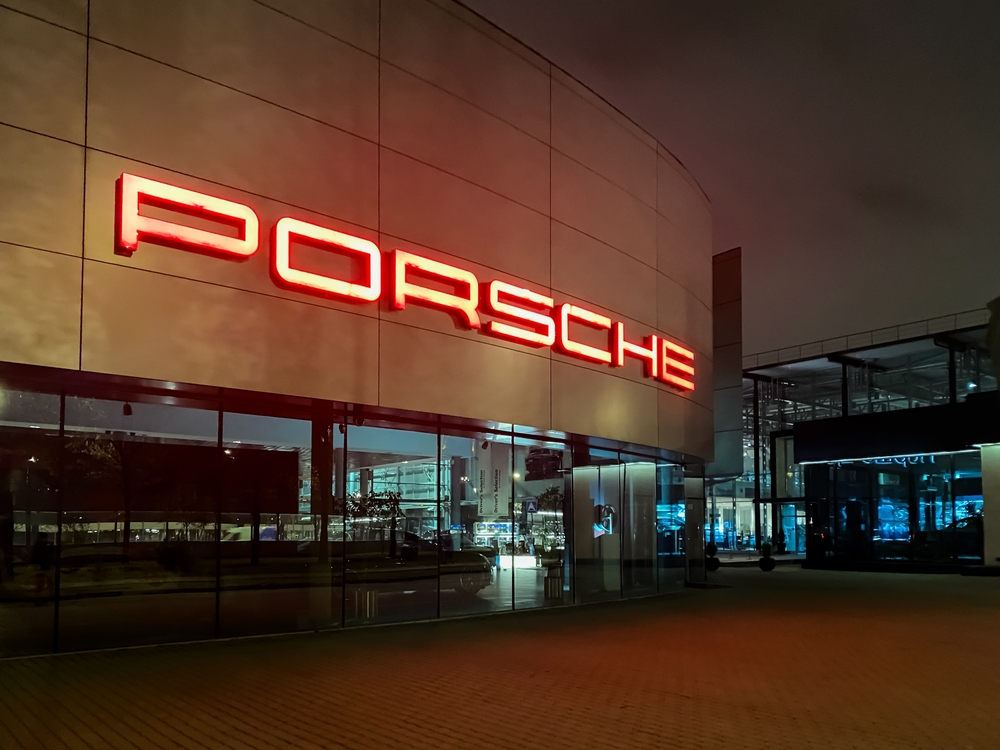
The German sports car manufacturer posted robust results for the fiscal year 2024. However, some key indicators showed a significant decline compared to the previous year. Operating return fell by more than 26% to 14%. The company's operating profit also declined, reaching €5.6 billion, a 22% year-over-year decrease from €7.3 billion. Revenue exceeded the €40 billion mark but was still 1.1% lower than in 2023. Cash flow net margin levels were above estimates at 10.2%, though slightly lower than last year’s 10.6%. The automaker reintroduced five of its six models to the market, including the Panamera, 911, Taycan, and Cayenne, as well as the fully electric Macan. According to CEO Oliver Blume, these models have laid the foundation for future success. Demand for the German luxury carmaker’s vehicles declined by 3% year-over-year in 2024.
Regional Contrasts
According to CFO Jochen Breckner, the company managed to maintain a strong level of profitability despite the adverse circumstances it faced. The reported declines were primarily driven by a significant drop in demand in China. Sales there fell by as much as 28% year-over-year due to the country’s challenging economic situation. The opposite was true for other regions. In Europe, the company saw an 8% year-over-year increase in demand, with Germany recording an 11% rise, while the U.S. market grew by 1%. Interest in cars remained strong overseas and in emerging markets, where sales rose by 6%. In addition to weak demand in Asia, supply chain issues caused further delays. Another challenge was the less-than-favorable situation for electric mobility in Europe. As a result, Porsche plans to focus more on combustion and hybrid engines in the coming years. However, it will continue producing fully electric models, particularly the Porsche Macan, which was introduced in September 2024.
A Broader European Issue
The entire automotive sector in Europe is facing challenges. Manufacturers are forced to raise the prices of their products due to high costs, which ultimately impacts consumer demand. According to January data from the European Automobile Manufacturers' Association (ACEA), demand fell by 2.6%. France recorded the lowest number of new registrations, with a decline of more than 6%, while in the eurozone’s largest economy, Germany, the drop was just under 3%. Although there was a slight year-over-year increase, it was less than 1%. Additionally, automakers are struggling with rising competition from Asia, strict CO2 regulations imposed by the European Union, and tariffs introduced by the United States. Many companies are adopting similar measures to Porsche. For example, due to these developments, German Ford-Werke's debt has risen to €5.8 billion. To reduce this debt and revive its business, its parent company, Ford Motor, will provide a financial injection of €4.9 billion. As reported by Reuters, Ford's Vice Chairman, John Lawler, took this opportunity to call on European politicians for clearer regulations that would primarily reflect market demand.
Expectations Are Not Optimistic
To mitigate negative impacts and improve its financial position, Porsche plans to invest €800 million in enhancing its product and software portfolio. As part of cost-cutting measures, the company will cut 1,700 jobs by 2029 and will not renew fixed-term contracts, affecting approximately 2,000 employees. The manufacturer’s outlook for 2025 is not entirely positive, as the business environment is expected to remain challenging with high costs. Porsche anticipates even more intense competition in Asia, along with tariff measures from the U.S. Revenue returns are projected to decline further, dropping below the currently reported figures to between 10% and 12%, with revenues expected to range between €39 billion and €40 billion.[1]
Porsche’s stock (P911), listed on the German Xetra exchange, is also struggling, reaching its lowest levels since its IPO in September 2022. On March 12, 2025, shares closed at €55.18, marking a 33% decline from the IPO price of €82.50. Compared to the same period last year, the drop is even steeper, at 37%.*
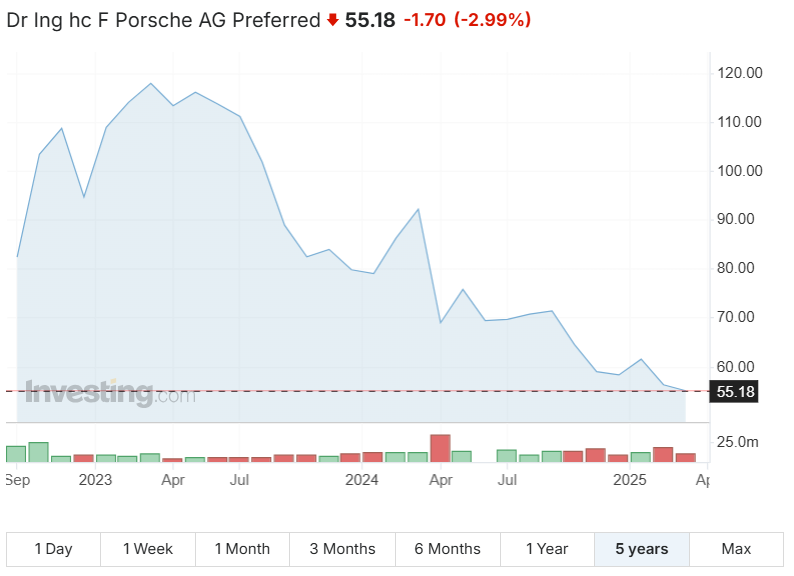
Source: Investing.com*
Conclusion
Porsche faced multiple challenges in 2024 but still managed to maintain relatively solid performance. Its strategic moves, including a renewed focus on combustion engine and hybrid vehicles, indicate an effort to achieve long-term stability amid increasing competition and shifting consumer behaviour. The success of the automotive industry in the coming years will not rest solely on the shoulders of manufacturers forced to adapt but will also depend on the European Union, which may need to reconsider its stance on strict regulations.[2]
* Past performance data is not a guarantee of future returns.
[1], [2] Forward-looking statements represent assumptions and current expectations that may not be accurate or are based on the current economic environment, which may change. These statements are not guarantees of future performance. Forward-looking statements, by their nature, involve risk and uncertainty because they relate to future events and circumstances that cannot be predicted and actual developments and results may differ materially from those expressed or implied by any forward-looking statements.
Warning! This marketing material is not and should not be construed as investment advice. Past performance data is not a guarantee of future returns. Investing in foreign currency may affect returns due to fluctuations. All securities transactions may result in both gains and losses. Forward-looking statements represent assumptions and current expectations that may not be accurate or are based on the current economic environment, which may change. These statements are not guarantees of future performance. InvestingFox is a trademark of CAPITAL MARKETS, o.c.p., a.s. regulated by the National Bank of Slovakia.
Sources:
https://newsroom.porsche.com/en/2025/company/porsche-deliveries-2024-38358.html