 English

 Slovak
 Czech
Czech
 Hungarian
 Italian
 Polish
 Slovenian






Pinterest closed the past quarter with revenue of $1.32 billion, narrowly missing estimates from analysts surveyed by the London Stock Exchange Group (LSEG) at $1.33 billion. However, the most significant hit was to net profit, which reached $277 million. This represents a significant 85% year-over-year drop, as the company managed a profit of $1.85 billion in the previous year. Lastly, the adjusted EBITDA figure of $541.5 million failed to meet analyst expectations. Combined with a weak Q1 outlook (projecting revenue below the analyst-expected $980 million threshold), this resulted in a nearly 20% drop in stock price on Friday.*
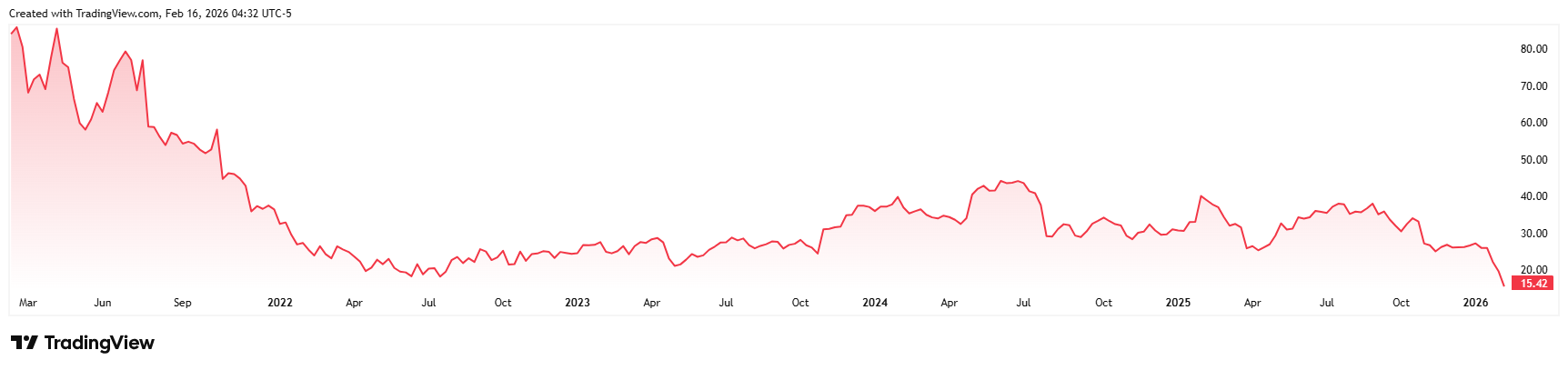
Pinterest stock price performance over the last five years*
Impact of Global Tariffs
The main cause of Pinterest's weakened financial performance is not user interest, as many investors likely think, but a specific external factor. CEO Bill Ready has spoken openly about challenges related to tariffs. Pinterest holds a specific position compared to its competitors—its advertising portfolio consists largely of major retailers. These retailers are most affected by new tariffs, which subsequently forced them to immediately and significantly cut digital advertising spend. This high exposure to retail makes Pinterest much more vulnerable to trade decisions than other giants operating in this segment.
Bet on AI
Company management is responding decisively to this unfavorable environment. In January, Pinterest announced a plan to lay off nearly 15% of its employees to increase efficiency. The changes also include a reduction in office space. However, the saved capital isn't just going into savings—according to management, capital expenditures are being directed toward AI. In other words, financial resources are being massively shifted to development teams working on next-generation algorithms for better product targeting and content personalization, aimed at driving profitability in the medium term.
The Power of Gen Z
Despite the financial risks mentioned above, the fundamental side—represented by the user base—remains exceptionally strong. The number of monthly active users grew by 12% year-over-year to a record 619 million. Critically for the future, Gen Z is the fastest-growing demographic group on the platform. This group views Pinterest not only as a place for inspiration but increasingly as a tool for direct shopping, which ultimately confirms the strategic direction toward the platform's e-commerce features.
Investment Perspective
The current situation has split leading investment banks into two camps. Citi downgraded the stock to Neutral, reflecting immediate risks associated with macroeconomic instability. On the other hand, Goldman Sachs acknowledges short-term headwinds but remains optimistic for the long term. For investors, the key question is whether the 20%+ correction is an overreaction to temporary macroeconomic influences or a signal of deeper structural problems. However, if Pinterest successfully integrates AI into its business model and maintains the favor of the younger generation, the current decline may be seen as a risky but potentially advantageous entry point for those who believe in the future of visual search.[1]
[1] Forward-looking statements represent assumptions and current expectations that may not be accurate or are based on the current economic environment, which is subject to change. These statements do not guarantee future performance. Forward-looking statements by their nature involve risk and uncertainty because they relate to future events and circumstances that cannot be predicted, and actual developments and results may differ materially from those expressed or implied in any forward-looking statements.
* Past performance data is no guarantee of future returns.
Sources:
https://investor.pinterestinc.com/financials/quarterly-results/default.aspx https://s204.q4cdn.com/369458543/files/doc_earnings/2025/q4/earnings-result/Q425-PressRelease.pdf
https://www.cnbc.com/2026/02/13/-pinterest-stock-price-tariff-earnings-layoffs.html