
Back to blog

Starbucks Suffers from Declining Sales, New CEO Plans to Turn Things Around

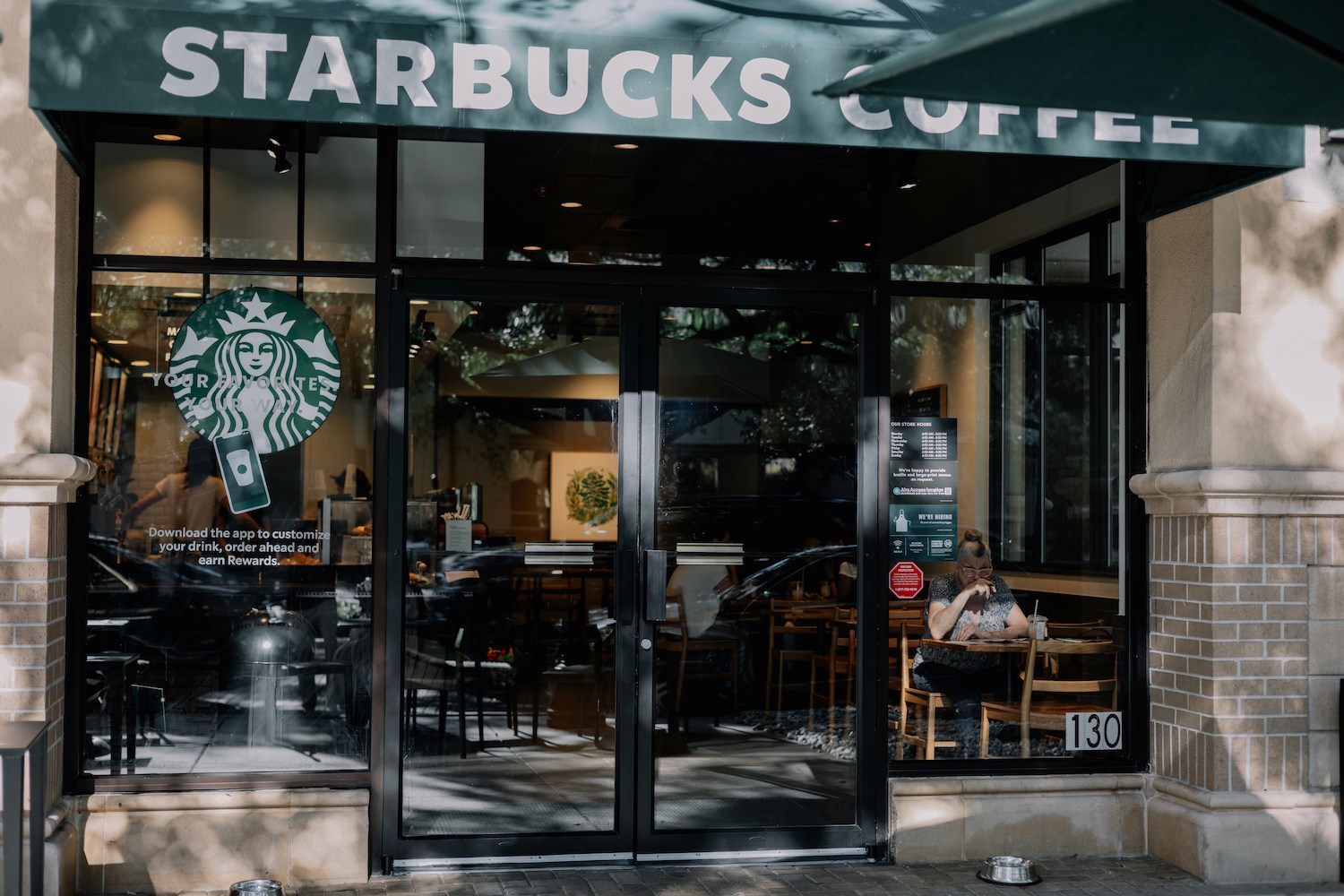
The well-known coffee chain Starbucks has been struggling with weaker sales for several months, as confirmed by the latest preliminary financial indicators for the fourth quarter of fiscal year 2024. However, there is hope in the form of a new CEO, who has a plan to reverse the situation. Starbucks must change its approach to customers while also listening to its employees, who have identified many operational issues.

Starbucks Suffers from Declining Sales, New CEO Plans to Turn Things Around

Financial results disappointed market expectations

Preliminary sales results for the Q4 FY 2024 (the three-month period ending September 29, 2024) show a year-on-year decline of 3% to $9.1 billion, and adjusted earnings per share (EPS) stand at $0.80, below the market’s consensus expectations, which had predicted revenues of $9.38 billion and EPS of $1.03.* Sales from existing stores fell by as much as 7% year-on-year, marking the biggest drop since the Covid-19 pandemic and the third consecutive quarter of decline. The main issue is weakened demand in key markets, such as North America, where Starbucks saw a 6% revenue drop by this metric, while in China, it was as much as 14%. The company attributes this to rising competition, which offers cheaper alternatives, changing consumer behaviour and preferences. Despite the disappointing results, Starbucks plans to increase its dividend from $0.57 to $0.61 per share to boost investor confidence.

Challenges for the new CEO

Under the leadership of its new CEO, Brian Niccol, Starbucks is now developing a new strategy to return to growth, prompting the company to suspend financial guidance for fiscal year 2025. Niccol, who previously served as CEO of Chipotle Mexican Grill, successfully tackled similar sales challenges at that company. The initiative, called “Back to Starbucks’ Plan,” aims to focus on the elements that once set the company apart from its competitors and made the brand popular. Niccol reportedly spent several weeks in Starbucks stores listening to feedback from both customers and employees. Based on what he heard, he emphasized the need to simplify procedures and refocus on high-quality coffee. However, these goals can only be achieved with motivated employees, who are currently facing difficult conditions, such as low wages and staffing shortages in various locations. Starbucks will present more concrete steps to address these issues on October 30, when it releases its full financial results for the past fiscal period.

Stock performance supported by new director and hedge fund

On Tuesday, October 22, after hours, Starbucks’ stock price dropped by more than 4% on Nasdaq, following the announcement of preliminary results for the past quarter. The stock had experienced significant losses this year until August, till Niccol was appointed to lead of the coffee giant, when they surged by almost 25%.* Starboard Value, an American hedge fund, has also decided to back the company with an investment, saying its shares are undervalued.

Snímek obrazovky 2024-10-29 v 11.47.11

Source: Investing.com*

Conclusion

Starbucks finds itself in a challenging position with declining revenues and weakening demand. However, the new CEO is determined to turn things around by listening to both consumer and employee feedback. Although the results have not yet met market expectations, focusing on core values could be a key step toward restoring confidence among customers and investors. [1]


* Data relating to the past are not a guarantee of future returns.

[1] Forward-looking statements represent assumptions and current expectations that may not be accurate or are based on the current economic environment, which may change. These statements are not guarantees of future performance. Forward-looking statements inherently involve risk and uncertainty because they relate to future events and circumstances that cannot be predicted, and actual developments and results may differ materially from those expressed or implied in any forward-looking statements.

Warning! This marketing material is not and must not be understood as investment advice. Data relating to the past are not a guarantee of future returns. Investing in a foreign currency can affect returns due to fluctuations. All securities transactions can lead to both profits and losses. Forward-looking statements represent assumptions and current expectations that may not be accurate or are based on the current economic environment, which may change. These statements are not guarantees of future performance. InvestingFox is a trademark of CAPITAL MARKETS, o.c.p., a.s. regulated by the National Bank of Slovakia.

David Matulay, analyst of InvestingFox

Sources:

https://www.cnbc.com/2024/10/22/starbucks-shares-slide-after-preliminary-results-show-sales-fell-again.html

https://www.investing.com/news/economy-news/starbucks-pulls-annual-forecasts-amid-turnaround-under-new-ceo-3676056

https://www.investing.com/news/stock-market-news/starbucks-baristas-and-customers-have-one-message-to-new-ceo-change-3676527

https://stories.starbucks.com/press/2024/starbucks-reports-preliminary-q4-and-full-fiscal-year-2024-results/

https://www.investing.com/news/economy-news/activist-starboard-value-takes-stake-in-starbucks-wsj-reports-3565259


InvestingFox is a trademark of CAPITAL MARKETS, o.c.p., a.s., with its registered office at Slávičie údolie 106, Bratislava – Staré Mesto district, 811 02. The company is registered in the Commercial Register of the Municipal Court Bratislava III, Section: Sa, File No.: 4295/B, ID No.: 36 853 054, VAT No.: 2022505419.

CAPITAL MARKETS, o.c.p., a.s. is a securities dealer pursuant to Section 55(1) of Act No. 566/2001 Coll. on Securities and Investment Services and on Amendments to Certain Acts, as amended (hereinafter the “Securities Act”). On October 30, 2007, CAPITAL MARKETS, o.c.p., a.s. was granted, by Decision No. OPK-2297/2007 of the National Bank of Slovakia -PLP, a license to provide investment services pursuant to Section 54(2) in conjunction with Sections 59(2) and (3) of the Securities Act, which was extended in accordance with the provisions of the Securities Act by Decision No. OPK-1830/2008-PLP dated April 21, 2008, Decision No. OPK-11601-1/2008 dated January 28, 2009, Decision No. ODT-5059-3/2012 dated July 23, 2012, and Decision No. ODT-9332/2014-1 dated October 21, 2014.

Read more

AutoZone Surprises Wall Street with Earnings: EPS Jumps 15%, but Weaker Sales Reveal Pressure on Customers

AutoZone Surprises Wall Street with Earnings: EPS Jumps 15%, but Weaker Sales Reveal Pressure on Customers

AutoZone closed fiscal year 2026 with results that appear very strong at first glance. Fourth-quarter revenue rose 5.6% year-over-year to $6.59 billion, net income increased to $931.6 million, and earnings per share reached $56.05, approximately 15% higher than a year ago and above Wall Street expectations. Beneath the surface, however, a weakness remains. Comparable sales growth fell short of forecasts, and American DIY car repairers continue to curb their purchases.1

Oracle Gains Momentum in AI: Cloud Revenue Grows 121%, Contracted Order Volume Reaches $664 Billion

Oracle Gains Momentum in AI: Cloud Revenue Grows 121%, Contracted Order Volume Reaches $664 Billion

Oracle kicked off the new fiscal year with results that once again confirmed that its transformation toward the cloud and artificial intelligence is gaining momentum. The company exceeded market expectations and demonstrated significant acceleration in the areas where it has directed the bulk of its investments in recent years. Behind the strong numbers, however, lies a question that will become increasingly important for investors. Oracle is growing rapidly, but the path to further expansion will be extremely costly. [1]

Casey’s Beat Expectations, but Shares Plummeted: Strong Earnings Overshadowed by a Slowdown in Sales

Casey’s Beat Expectations, but Shares Plummeted: Strong Earnings Overshadowed by a Slowdown in Sales

Casey’s General Stores kicked off fiscal year 2027 with results that, at first glance, appear very impressive. However, behind the strong numbers lies a story that is significantly more complex and raises more questions than clear answers for investors. The market isn’t just looking at how much the company earned, but also at how it achieved this result and whether it will be able to maintain a similar pace in the coming quarters.

The End of Visionary Dreams: In Autonomous Transportation, It’s No Longer the Cars That Matter, but Logistics

The End of Visionary Dreams: In Autonomous Transportation, It’s No Longer the Cars That Matter, but Logistics

Waymo has entered a phase where it’s no longer just about whether an autonomous car can safely navigate a city. What matters most is how many vehicles the company can deploy, how quickly it can enter new markets, and whether it can keep costs under control in the process. This is precisely where a technological demonstration differs from the real transportation business.