 English

 Slovak
 Czech
Czech
 Hungarian
 Italian
 Polish
 Slovenian





TD SYNNEX’s revenue reached $21.56 billion, compared to $15.65 billion a year ago. Gross profit rose 26.2% to $1.43 billion, and operating profit jumped 67.6% to $643 million. Net income increased even more sharply, from $227 million to $416 million, representing year-over-year growth of more than 83%. Diluted earnings per share under GAAP reached $5.18, compared to $2.74 a year ago.
The results look even more impressive when compared to market expectations. Adjusted earnings per share of $5.68 beat the analyst consensus of around $4.63, and revenue of $21.56 billion was significantly above the estimate of approximately $18.9 billion. Nevertheless, TD SYNNEX shares fell by approximately 9% during after-hours trading following the earnings release.* This indicates that simply beating estimates was not enough for investors this time around.1
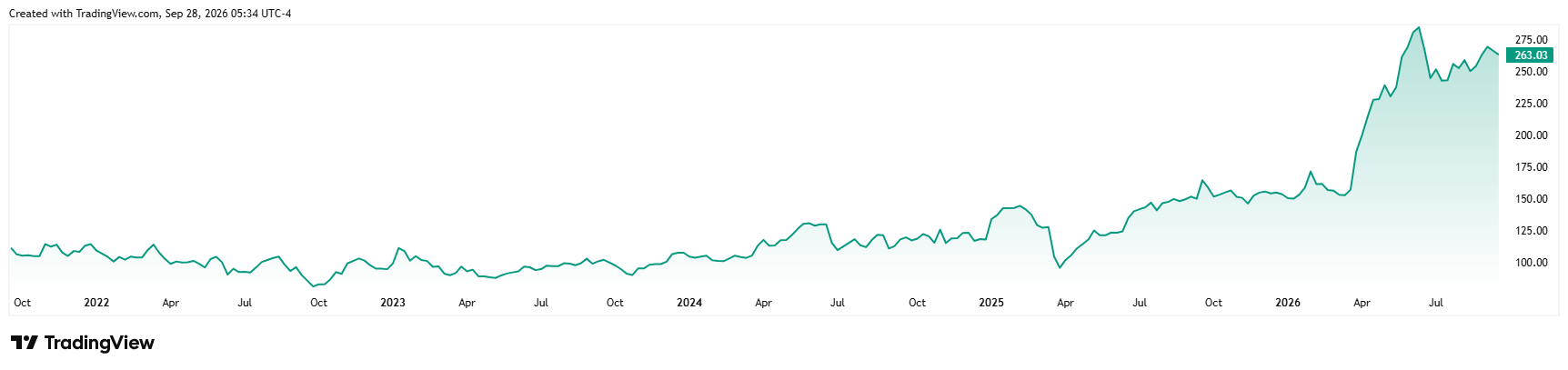
TD SYNNEX Stock Price Performance Over the Past Five Years*
Distribution is growing across the portfolio, but Hyve is exploding
The traditional distribution business remains the company’s largest segment and continues to grow very rapidly. Gross billings for the Distribution division rose 27% to $24.8 billion, with the company posting double-digit growth in all geographic regions. Endpoint Solutions grew 16%, driven primarily by higher average prices for computers. Advanced Solutions grew even faster, by 37%, driven primarily by infrastructure, software, and technologies related to artificial intelligence. Distribution’s adjusted operating profit rose 55% to $483 million.2
However, the real growth driver is Hyve, which designs, manufactures, and provides infrastructure for large technology customers. Hyve’s gross billings reached $7 billion, jumping 117% year-over-year. The manufacturing segment grew by more than 130% and accounted for approximately two-thirds of Hyve’s revenue, while supply chain services grew by more than 90%. The division’s gross profit rose 47% to $276 million, and adjusted operating profit rose 56% to $253 million.2
AI is the main driver of growth, but it creates a new challenge
The results clearly show that TD SYNNEX is among the companies benefiting from massive investments in data centers and AI infrastructure. Management noted that the enterprise use of artificial intelligence is gradually shifting from testing to broader production deployment. At the same time, the company is expanding its presence with major technology partners. In August, for example, it expanded the distribution of IBM products to 20 additional countries and, over the course of the year, also expanded its offering of infrastructure built on NVIDIA platforms. It is precisely this combination of distribution, servers, software, and data infrastructure that enables TD SYNNEX to generate revenue across multiple stages of the AI investment cycle.1
However, the rapid growth of AI infrastructure is leading to weaker margins. TD SYNNEX’s total gross margin fell from 7.22% to 6.61%. In the case of Hyve, the adjusted operating margin calculated from gross revenue decreased from 5.04% to 3.61%. Management attributes this trend to the growing share of large AI rack programs, which generate high volumes but lower margins. This is one of the most important details of the results, because while the company is growing exceptionally fast, every new dollar in the AI business may not yield the same profitability as the traditional parts of the portfolio.2 [1]
Cash flow is the weakest point in the results
The biggest red flag in the results is not profit, but cash. TD SYNNEX reported a negative operating cash flow of approximately $917 million during the quarter. After accounting for capital expenditures of approximately $59 million, the consumption of free cash flow reached approximately $1 billion. By comparison, during the same period last year, the company generated approximately $246 million in cash from operating activities.1
This trend is primarily driven by the sharp increase in working capital required to support Hyve’s new programs. Inventory levels climbed to $15.29 billion by the end of August, compared to $9.50 billion at the end of November 2025. Cash on hand fell from $2.44 billion to approximately $749 million over the same period. Management states that this is primarily due to investments related to onboarding new customers and programs and expects that a portion of the capital invested will begin to be released as early as the next quarter.12 [2]
The outlook remains strong, but the market wants higher-quality growth
TD SYNNEX expects revenue of $21.8 billion to $22.6 billion and non-GAAP gross billings of $31.4 billion to $32.4 billion in the fourth fiscal quarter. Adjusted net income is expected to reach $454 million to $494 million, and the company anticipates adjusted earnings per share of between $5.65 and $6.15. Management also anticipates further quarter-over-quarter growth for Hyve, as programs with new customers are set to ramp up further. The company also expects to return to cash generation during the fourth quarter.12 [3]
It is precisely the combination of margins and cash flow that will be decisive following a record quarter. TD SYNNEX has already demonstrated that it can generate double-digit revenue growth from increasing investments in AI and data centers and more than double Hyve’s revenue. Now it must demonstrate that it can gradually convert this growth into stable cash flow and that pressure on margins will not worsen further. The sharp negative reaction of the stock following the earnings report suggests that investors currently place greater emphasis on the quality of growth than on the pace of expansion itself. If cash flow improves in the coming quarters and Hyve maintains high growth without a further significant decline in margins, the current record figures will gain a substantially stronger financial foundation. [4]
[1,2,3,4] Forward-looking statements are based on assumptions and current expectations, which may be inaccurate, or on the current economic environment, which is subject to change. Such statements do not constitute a guarantee of future performance. They involve risks and other uncertainties that are difficult to predict. Actual results may differ materially from those expressed or implied in any forward-looking statements.
* Past performance is no guarantee of future returns.