 English

 Slovak
 Czech
Czech
 Hungarian
 Italian
 Polish
 Slovenian





Security teams in practice often use many standalone tools from different vendors. This increases complexity, costs, and worsens incident response time. Palo Alto therefore communicates a platform approach, where network security, cloud, SOC, and identity are combined into a single ecosystem with unified data and automation. AI enters this in two ways. On the one hand, it increases the volume and speed of attacks, so companies want more automation and better telemetry processing. On the other hand, more new places emerge through which an attacker can strike when companies deploy models, AI agents, plugins, and connections to internal data. This creates room for new products as well as new acquisitions.
AI acquisitions as an accelerator of the product portfolio
The most visible AI direction was the announcement of the acquisition of Protect AI, which focuses on specific risks around AI and machine learning, including models, data, and the runtime layer. This type of capability can be connected directly to the security platforms that Palo Alto already sells to large enterprises, so the company gains faster entry into a new category without having to build everything from scratch. Another piece of the puzzle is Koi, where the company communicates a shift toward protecting the agentic endpoint. In other words, it is the reality where endpoints are running not only user applications, but also scripts, plugins, and AI tools with access to data and systems. Acquisitions in this area are meant to support the vision that Palo Alto will address security even for new AI-based workflows.
CyberArk and Chronosphere change the business and cost mix
The acquisition of CyberArk moves Palo Alto into identity protection, an area that has become one of the most important security pillars in recent years. Identity is often the first point through which an attacker gains access, and with AI, this problem is multiplied by the growth of machine identities and autonomous agents. Palo Alto thereby gains a strong platform for protecting and controlling administrative access, which allows it to offer customers a broader package of security services.
Chronosphere, in turn, moves the company toward better monitoring and visibility into what is happening in the cloud and applications. At first glance, this may look outside of cybersecurity, but in practice, a modern SOC is built on data. As the volume of logs, events, and telemetry grows, costs grow as well. Integrating monitoring tools and gaining better insight into what is happening in systems makes sense if the company can reduce the number of unnecessary alerts and speed up automated incident response. At the same time, however, it is another major integration that increases costs in the short term.
Rising costs and why management lowered the profitability outlook
In fiscal Q2 2026, Palo Alto grew in revenue as well as in key recurring metrics. Revenue increased year over year by 15% to approximately USD 2.6 billion. Next Generation Security ARR increased by 33% to USD 6.3 billion, and RPO grew by 23% to USD 16 billion. On an adjusted earnings basis, the company delivered USD 1.03 per share, which suggests that the core business is still working.*
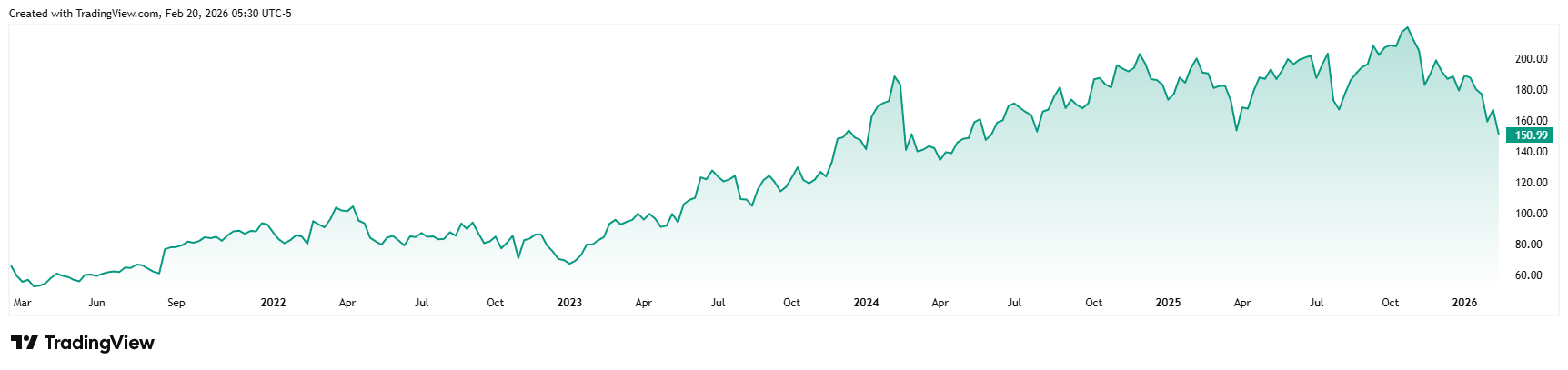
Stock price performance of Palo Alto Networks over the last five years.
However, the market focused more on what comes next. After a series of large acquisitions, the company acknowledged higher integration costs and lowered the adjusted earnings outlook for fiscal year 2026. At the same time, it did raise the revenue outlook, but investors saw the classic trade-off: faster platform building now, weaker profitability in the short term. That is also why the shares fell sharply after the results, even though the quarterly numbers themselves were solid.
Pressure on profitability and what the company must deliver next
The biggest risk in such an acquisition wave is not the sheer size of the purchases, but the ability to turn them into a single offering that customers actually buy as a platform. If the products cannot be integrated quickly, the result is a higher cost base without a corresponding acceleration of sales. That is precisely the moment when margins start to deteriorate, and investors lose patience.
For Palo Alto, it is therefore crucial to show two things. The first is that recurring revenue growth remains strong even after stripping out acquisitions. The second is that integration costs have a clear peak and are then followed by a scaling effect, where the platform starts to deliver higher efficiency in sales, support, and operations. If this succeeds, short-term pressure on profitability can turn into long-term sustainable growth with higher margins.[1]