 English

 Slovak
 Czech
Czech
 Hungarian
 Italian
 Polish
 Slovenian





Applied Materials reported revenue of $9.115 billion for the quarter ended July 26, representing year-over-year growth of 25% and a new all-time high for the company. According to LSEG data, Wall Street had expected approximately $8.99 billion. The company recorded even more significant growth in profits. GAAP net income rose 43% to $2.54 billion, and earnings per share increased from $2.22 to $3.17. After adjusting for selected one-time items, earnings per share reached a record $3.50, representing a 41% year-over-year increase. Applied Materials’ growth was thus not driven solely by higher sales volume. The company was also able to translate a significant portion of its revenue growth into higher profitability.[1]
The strong results are also evident in the margins. The GAAP gross margin rose from 48.8% to 50.3%, and the adjusted gross margin reached 50.4%. The adjusted operating margin increased from 30.7% a year ago to 34%, while adjusted operating income jumped 38% to $3.10 billion. The company also generated a record operating cash flow of $3.04 billion, and free cash flow reached $2.33 billion. It returned $860 million to shareholders during the quarter, of which $440 million was through share buybacks and $420 million through dividends. At the end of the quarter, it also still had an authorized share buyback program of $12.8 billion.1
AI Is Changing the Structure of Demand for Chip Manufacturing Equipment
These record figures are primarily driven by the ongoing expansion of AI infrastructure, which is increasing the need for more powerful processors, memory, and new ways of interconnecting chips. The largest segment, Semiconductor Systems, increased quarterly revenue from $5.56 billion to $7.04 billion. Of this, 67% came from equipment for foundries, logic chips, and other applications, while the share of DRAM memory rose from 22% to 26%. The segment’s operating margin also increased from 33% to 37.7%. Applied Materials states that advanced logic chips, DRAM, and advanced packaging currently account for approximately 80% of the growth in the wafer fabrication equipment market. This is particularly important for the company, as management asserts it has a strong technological position in precisely these areas.1
Advanced chip packaging, in particular, is growing exceptionally rapidly; it is essential for integrating high-performance AI processors with high-bandwidth HBM memory. Just a few months ago, Applied Materials expected its revenue from this segment to grow by more than 50% in calendar year 2026. Following the latest developments, the company has raised its estimate to more than 70%. The company also announced new equipment for advanced packaging, DRAM, and manufacturing process control. According to management, the standalone business focused on diagnostics and production control is expected to grow by more than 50% in 2026. Applied Global Services, in turn, is projected to grow by more than 20%. For Applied Materials, therefore, AI does not mean a single new product, but rather growing demand across multiple segments of its portfolio.1 [2]
The outlook suggests that growth is far from over
Even more important than the past quarter itself may be what Applied Materials expects going forward. For the fourth fiscal quarter, the company forecasts revenue of approximately $10.25 billion, with a possible variance of $500 million. The midpoint of the forecast is significantly above the Wall Street consensus of approximately $9.54 billion. Adjusted earnings per share are expected to reach approximately $4.02, with a possible range of $0.20, while analysts had expected approximately $3.69 prior to the earnings release. The Semiconductor Systems segment alone is expected to generate approximately $7.9 billion in the next quarter, and Applied Global Services approximately $1.84 billion. The adjusted gross margin is expected to remain around 50.4%.[2] [3]
Management is not only providing a positive outlook for the next three months. CFO Brice Hill stated that the company has a longer-term outlook on future demand from customers than ever before, with some discussions already extending as far as 2030. Applied Materials is therefore significantly expanding its own manufacturing capabilities. In recent years, it has nearly doubled its manufacturing space, and by 2028, it aims to double its quarterly system production capacity compared to current levels. At the same time, it is already preparing for further expansion, which would enable the company to respond to even higher demand by the end of the decade. In the last quarter alone, the company hired more than 1,500 employees in manufacturing and customer support.1[3]
Why Shares Fell Despite Strong Results
At first glance, the investors’ reaction is surprising. Applied Materials beat revenue expectations, presented a better outlook than the market had anticipated, raised its growth forecast for advanced packaging, and pointed to strong demand through at least 2027. Nevertheless, the stock fell 5.1% in the following trading session.* The main issue was not a weak report, but the level of expectations, which had risen exceptionally high following a sharp rise in the stock price. Applied Materials’ stock had more than doubled since the beginning of the year ahead of the earnings report. Investors had thus already priced in a significant portion of the expected growth associated with AI infrastructure and needed an even stronger catalyst for further significant appreciation.2
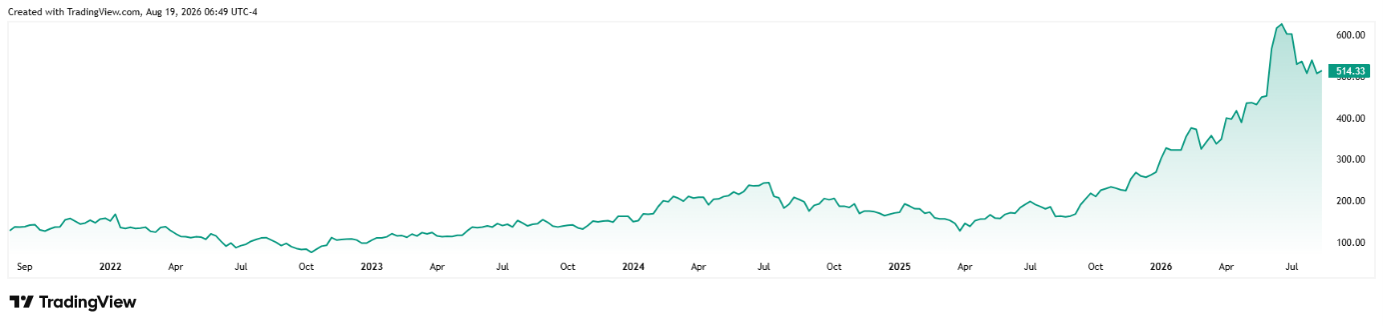
Applied Materials’ stock price performance over the past five years*
The second factor is competition. Applied Materials competes for chipmakers’ capital expenditures with companies such as Lam Research, KLA, and ASML, and investors are comparing the growth rates of individual suppliers with increasing rigor. Reuters noted that, according to Summit Insights Group, Applied Materials’ revenue growth lagged behind some competitors. Morgan Stanley described the results as good but pointed out that, in the current earnings season for semiconductor equipment manufacturers, the difference between a good and an exceptional report is significant for the stock price. Immediately following the earnings release, Applied Materials was trading at approximately 32 times expected earnings for the next twelve months. At this valuation, the market is no longer paying only for current earnings but also for the expectation that the high growth rate will continue.[4] [4]
What the Market Will Watch Next
The most important question now will not be whether there is demand for AI, but how long it can grow at a pace that justifies today’s investor expectations. Applied Materials states that demand for the advanced semiconductors needed for AI infrastructure significantly exceeds supply, and chip manufacturers are striving to increase production at existing factories and accelerate the launch of new capacity. During the quarter, the company recorded more than ten new semiconductor factory projects announced by customers. From the perspective of further growth, the pace of investment in cutting-edge logic chips, DRAM, HBM, and advanced packaging will be particularly crucial. If the construction of AI data centers remains strong, Applied Materials can benefit not only from the building of new production capacity but also from efforts to extract higher performance from existing fabs.[5] [5]
For investors, however, the coming quarters will set a much higher bar. The company will have to demonstrate that it can not only fulfill growing orders but also continue to increase margins and capture a sufficient share of chipmakers’ new investments. A positive sign is that the company’s gross margin has been growing year-over-year for thirteen consecutive quarters, and management attributes part of the improvement to higher product prices and a more efficient cost structure. Applied Materials is thus facing an unusually strong period in terms of fundamentals. The problem is not a lack of growth, but rather how much of that growth investors have already priced into the stock. Third-quarter results showed that the AI investment cycle is driving record revenue and profits for the company. However, the market’s reaction also served as a reminder that, for the most successful AI stocks, even a record may not automatically be good news for the stock price.
[1,2,3,4,5] Forward-looking statements are based on assumptions and current expectations, which may be inaccurate, or on the current economic environment, which is subject to change. Such statements are not guarantees of future performance. They involve risks and other uncertainties that are difficult to predict. Actual results may differ materially from those expressed or implied in any forward-looking statements.
* Past performance is no guarantee of future returns.
[1] https://ir.appliedmaterials.com/static-files/425ac634-4ee7-4c41-a07f-fa9e3c42b797
[2] https://www.reuters.com/business/applied-materials-forecasts-quarterly-revenue-above-estimates-2026-08-13/
[3] https://ir.appliedmaterials.com/static-files/e9985149-77c2-4cf3-aaad-a579178cbfe4
[4] https://www.reuters.com/business/applied-materials-slips-investors-seek-faster-growth-after-stellar-run-2026-08-14/
[5] https://ir.appliedmaterials.com/static-files/9d5d182d-f060-4b22-a32c-4582257fdc9b