 English

 Slovak
 Czech
Czech
 Hungarian
 Italian
 Polish
 Slovenian





Breaks Records Again, But High Gross Margins Raise Concerns
In the last quarter of fiscal year 2025 (the three-month period ending January 26, 2025), Nvidia reported the revenue of $39.3 billion, a year-on-year increase of 77.9%. Net income reached $22.1 billion, and net profit margin rose to 56%, meaning the company still keeps most of its revenues. The main revenue driver for the last three months was the data centre segment, primarily the Blackwell architecture. Despite strong results, the company’s stock dropped* as the outlook for lower gross margins caused uncertainty. The estimated value for the current quarter is 70.6%, down from 75% in the same period last year.
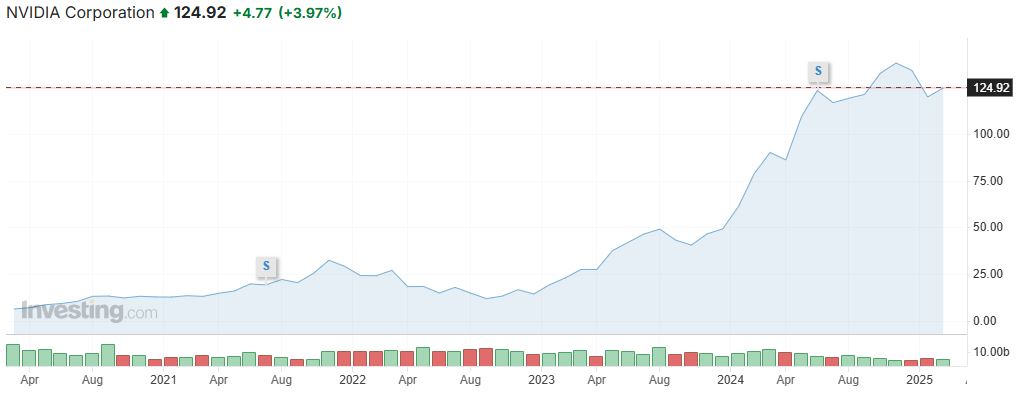
Source: Investing.com*
Decline in Gaming Segment and Increasing Competition
Nvidia’s gaming segment revenues dropped to $2.5 billion in Q4, a 22% decline compared to the previous quarter. This segment mainly includes graphics cards, with the new RTX 50 series recently launched. The decline may be linked to the cyclical nature of this market, as well as increasing competition. AMD and Intel are expanding their graphics card portfolios, with AMD focusing on a better price/performance ratio and Intel gaining market share in the mainstream GPU segment. Additionally, the rising presence of China’s Huawei in the chip industry could pose a longer-term challenge, as Nvidia faces export restrictions in Asian country.
Chip Production is Secured for This Year
According to Taiwanese media, Nvidia has already secured more than 70% of the production capacity from its main supplier, TSMC, for this year. This move is in response to the growing demand for the aforementioned Blackwell chips. As the world's largest contract chipmaker, TSMC is playing a key role in the technology shift. It is the only company that provides advanced chip packaging processes en masse, which also predisposes it to strong growth. Securing advanced chip packaging for Nvidia is a clear indicator for investors that companies in this field will continue to have a strong position in the global market. TSMC’s results for the last quarter, showing significant growth, confirm that the company is preparing for another wave of demand and expanding its capacity. The year 2025 will thus be crucial for technology giants.
Market Uncertainty in the US Continues
Nvidia’s stock decline is also tied to the overall bearish trend in US markets, which are shaken by uncertainty related to the imposition of tariffs on imports to the US. Trump confirmed a 25% tariff on goods from Canada, Mexico, and an additional 10% on China. This could have a significant impact on semiconductors, as the country remains dependent on imports, particularly from Taiwan. This is unlikely to change in the near future, despite the CHIPS and Science Act, an initiative by the US government aimed at bringing the majority of advanced chip production back to the US.
The release of unemployment claims data on Thursday, which exceeded consensus estimates, also negatively impacted the markets, indicating potential weakness in the labour market.
Conclusion
Nvidia maintains a strong position and dominance in the AI sector but may face slower growth in the coming quarters. Over the past two years, it has been a major driver of Wall Street, and investors hope it will maintain this pace. The uncertainty over the past weeks was caused by the release of the Chinese app DeepSeek, which is said to contain revolutionary language models without the need for expensive advanced hardware. This brings the potential for lower AI development costs, which could hurt companies profiting from this technology. Challenges also come from changes in US trade policy, which could disrupt supply chains, still highly concentrated in the semiconductor industry.
* Historical data is not a guarantee of future returns.
Warning! This marketing material is not and should not be construed as investment advice. Historical data is not a guarantee of future returns. Investing in foreign currencies may affect returns due to fluctuations. All securities transactions may result in both profits and losses. Forward-looking statements represent assumptions and current expectations that may not be accurate or are based on the current economic environment, which may change. These statements do not guarantee future performance. InvestingFox is a trademark of CAPITAL MARKETS, o.c.p., a.s. regulated by the National Bank of Slovakia.
Sources:
https://www.congress.gov/bill/117th-congress/house-bill/4346
https://tradingeconomics.com/calendar
https://www.investing.com/news/stock-market-news/nvidia-q4-results-top-estimates-3894086