 English

 Slovak
 Czech
Czech
 Hungarian
 Italian
 Polish
 Slovenian





The conflict between banks and fintech startups over who should pay for access to client data has been ongoing for several years. However, the situation has now reached a point where we are witnessing the first compromise. JPMorgan will now start charging fees for API access to data, fundamentally changing the nature of open banking in the United States. "The contracts will make the open banking ecosystem safer and more sustainable, enabling clients to continue using their favorite financial products reliably and securely, and the market has functioned," said the bank’s spokesperson, Drew Pusateri.
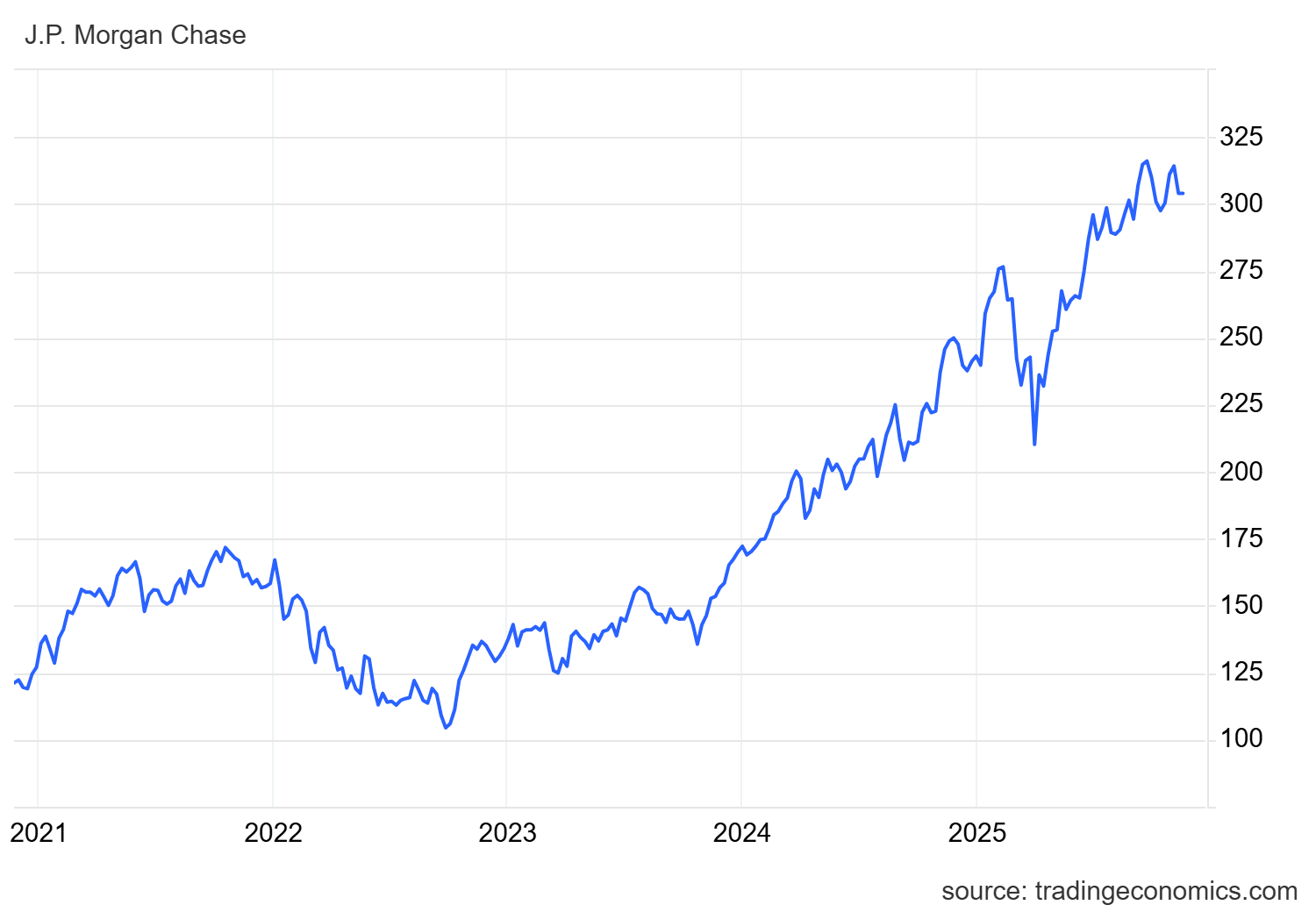
Performance of JPMorgan Chase’s Stock Price Over the Last Five Years*
On the other hand, the situation should be viewed in a more complex manner – for the first time, banks are gaining real control over the data flows driving the fintech ecosystem.
From Regulation to Monetization
As mentioned above, JPMorgan did not arrive at this agreement by chance. Within the genesis of court proceedings, it is crucial to highlight the turning point in 2024 when the Consumer Financial Protection Bureau (CFPB) adopted the so-called open banking rule, mandating banks to share data for free. However, after the arrival of Donald Trump’s administration, the situation drastically changed. In May 2025, the government requested a federal court to immediately revoke the rule. This step paved the way for a new market model where data is directly transformed into a commercial commodity. Following this, JPMorgan immediately announced its intention to charge fintech companies hundreds of millions of USD.
Long-Term Potential
Naturally, JPMorgan achieved its desired strategic solution. The bank gains a new, and most importantly, stable source of income outside traditional lending and investment banking – this time from data infrastructure. Access fees from large fintech firms could generate hundreds of millions of USD annually, while also allowing the bank to fund the development and maintenance of its API systems.
More importantly, JPMorgan is securing its position as a gateway to financial data, through which all leading fintech applications must pass. Last but not least, the bank has been performing well on the stock market; since the beginning of the new decade, it has seen stable stock price development, with the company’s value increase this year already over 25%.*
*Past data is not a guarantee of future returns.
Disclaimer! This marketing material is not and should not be construed as investment advice. Past data is not a guarantee of future returns. Investing in foreign currency may affect returns due to fluctuations. All securities transactions may lead to both gains and losses. Forward-looking statements represent assumptions and current expectations, which may not be accurate or may be based on the current economic environment, which may change. These statements do not guarantee future performance. InvestingFox is a trademark of CAPITAL MARKETS, o.c.p., a.s., regulated by the National Bank of Slovakia.
Sources:
https://www.cnbc.com/2025/11/14/jpmorgan-chase-fintech-fees.html
https://www.cnbc.com/2025/07/28/jpmorgan-fintech-middlemen-plaid-data-requests-taxing-systems.html
https://www.cnbc.com/2025/07/31/jpmorgan-1000th-branch-opening-expansion-plans.html