 English

 Slovak
 Czech
Czech
 Hungarian
 Italian
 Polish





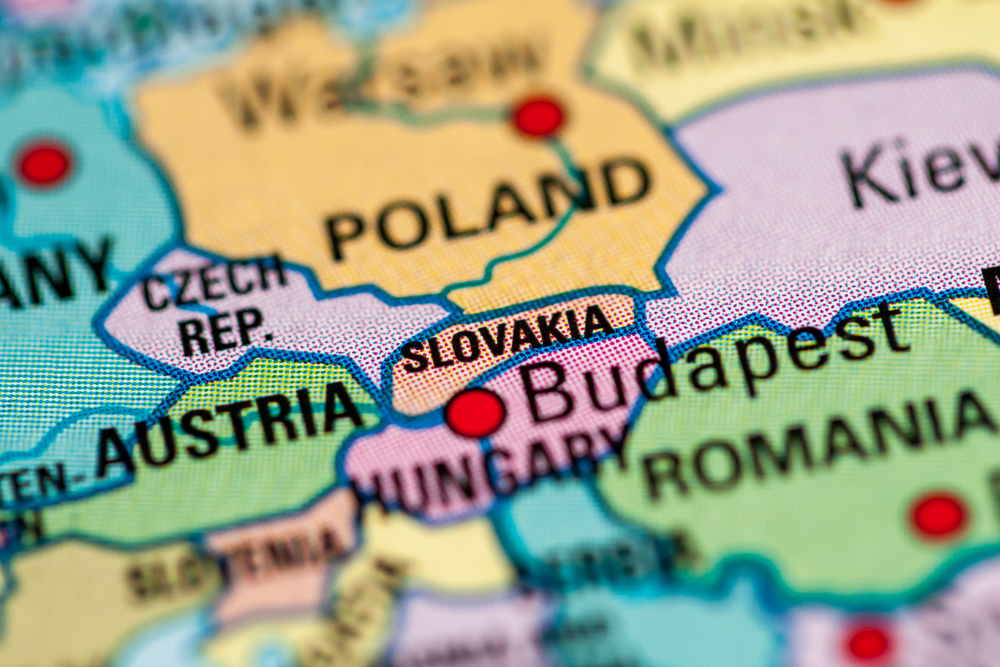
According to data provided by the European Commission, Slovakia is expected to grow the slowest among the V4 countries over the next three years. Beginning with the current year, real year-on-year GDP growth for 2025 is estimated at 0.8%, while during the following two years the situation should gradually improve, GDP in 2026 and 2027 will likely rise to 1.0% and 1.4%. A specific combination of factors is responsible for these relatively low values. Although public investment plays an important role, its effect is currently weakened by the negative impact of net exports, especially due to higher U.S. tariffs, to which Slovak industry, primarily the automotive sector, is extremely sensitive, and simultaneously by weakening private consumption, which is declining in response to fiscal consolidation and higher taxes. The forecast states that a certain revival of exports will occur only in 2027, when production is expected to start at the new car factory.
Czechia
On the other hand, according to the European economic forecast, the Czech Republic shows significantly more stable development within the V4, with its primary strength resting on the balance between domestic demand, i.e., household consumption, and investment activity. For 2025, real GDP growth compared to the previous year is expected to reach 2.4%. Although the pace is expected to slow to 1.9% the following year, in 2027 it should regain strength and reach 2.4% again. As mentioned above, the Czech economy in 2025 is driven mainly by private consumption, especially thanks to the growth of real wages and declining household savings rates. Looking ahead to the following year, growth is expected to slow temporarily, but the forecast for the next year again indicates potential acceleration supported by fiscal stimuli and higher defense spending by business partners.
Hungary
The Hungarian economy as a whole enters the projected period with the weakest macroeconomic baseline. For the current calendar year, GDP is estimated to grow by only 0.4% compared to the previous year, signaling the weakest result in the region. A dramatically different situation should occur in 2026, when Hungary is expected to accelerate to 2.3%, though this positive trend is likely to end there, as growth in 2027 is expected to slow again to 2.1%. Regarding the weak performance in 2025, the main factors are low investment activity and weakened exports, especially due to the decline in industrial product exports. Conversely, the recovery in 2026 will be supported by government fiscal stimuli and wage growth. Exports are also expected to rise, thanks to the launch of new factories in the automotive sector and an overall improvement in foreign demand.
Poland
Lastly, the Central European region is dominated by Poland, which maintains relatively strong growth dynamics. Real GDP is expected to increase by 3.2% year-on-year this year, by 3.5% in 2026, and slightly decline to 2.8% in 2027. Poland’s performance is driven by strong private consumption, which benefits from the growth of real disposable income, and by high public investment, particularly in defense and projects funded by the European Union. Accordingly, the year 2027 will likely represent a short-term correction phase, during which the economy naturally slows. Nevertheless, Poland remains the most robust economy in the region, supported by a stable labour market and rising household incomes.
Different Trajectories, Shared Challenges
The latest economic projection for the Visegrad Four countries for the years 2025 to 2027 confirms that the region, on one hand, functions effectively through cooperation, while on the other hand the individual countries are developing in quite different ways. Poland is becoming one of the main engines of growth, Czechia maintains stable development, while Slovakia and Hungary face systemic challenges limiting their growth potential. For those shaping the future direction of economic policy, it therefore remains crucial to monitor how quickly neighbouring countries can respond to the changing global environment.
Warning! This marketing material is not and should not be construed as investment advice. Past performance is not a guarantee of future returns. Investing in foreign currencies may affect returns due to fluctuations. All securities transactions can result in both profits and losses. Forward-looking statements represent assumptions and current expectations that may not be accurate or are based on the current economic environment, which may change. These statements do not guarantee future performance. InvestingFox is a trademark of CAPITAL MARKETS, o.c.p., a.s., regulated by the National Bank of Slovakia.