English

 Slovak
 Czech
 Hungarian
 Italian
 Polish
 Slovenian


On September 1, Waymo launched public rides in Denver, San Diego, and Tampa, expanding its operations to 14 U.S. cities. The fleet has surpassed 4,000 autonomous vehicles, and the new Ojai platform is being rolled out. The company was already providing approximately 500,000 paid rides per week this spring and aims to reach one million rides per week by the end of 2026. For this reason alone, this is no longer an experiment with a few dozen cars, but a logistics network in which the growth in the number of rides increases the demands on production, service, charging, and fleet management. This volume provides real-world data on vehicle utilization and downtime.[1]
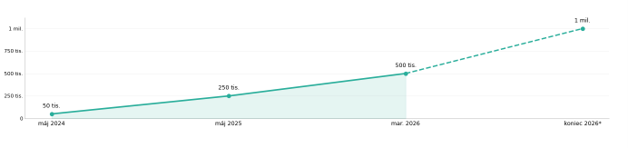
Trend in Waymo’s weekly number of paid rides and target for the end of 2026*
The pace at which Waymo enters new cities is also important. First, it maps and tests the environment; then it removes the safety driver; and finally, it opens the service to employees, invited users, and the public. This model is slower than an immediate nationwide rollout, but it reduces the risk of expanding operations before local processes and regulatory approvals are in place. Waymo is, however, shortening this process. If fleet growth is combined with the faster opening of new zones, the main bottleneck may not be autonomous technology, but the ability to manufacture and operate enough vehicles.1 [1]
Waymo Driver is evolving into a scalable technology platform
The company designed the sixth generation of the Waymo Driver system so that it is not tied to a single car model. The same architecture can be adapted to both the Ojai platform and the electric Hyundai IONIQ 5, with sensors and software configured according to the vehicle. Waymo has also simplified the hardware and uses less expensive lidar and radar components without sacrificing sensor redundancy. From a business perspective, this is a fundamental shift. The company isn’t trying to become an automaker, but rather a supplier of an autonomous driving system that can be integrated into multiple vehicle bodies and produced in larger volumes. This reduces dependence on a single manufacturer and opens the door to additional platforms.[2]
This approach is already being reflected in production. At its facility near Phoenix, Waymo is preparing for a production capacity of tens of thousands of systems per year and is collaborating with automakers to ensure that base vehicles come ready for the integration of autonomous technology. Lower hardware complexity is expected to reduce the cost of the next generation and enable operation across a wider range of conditions, including winter weather. If the model proves successful, the economics could improve in two ways simultaneously: through lower vehicle costs and higher utilization of the same software core. Higher volume simplifies maintenance and parts supply, which is just as important for continuous operation as the price of sensors.2
Tesla and Waymo are pursuing completely different strategies
Tesla represents the most striking contrast in the market. Waymo uses a combination of cameras, lidar, radar, and detailed maps, and conducts mapping, simulations, and local testing before entering a city. Tesla, on the other hand, seeks to achieve broader scalability using cameras and artificial intelligence with less reliance on sensors and site preparation. Tesla’s advantage is clear. If the technology works reliably, expansion can be cheaper and faster. Waymo, however, is built on the opposite premise: that controlled expansion and redundant environmental sensing are a necessary cost for fully autonomous operation without a human behind the wheel.[3] [2]
The difference between the two approaches also has an investment dimension. Some analysts attribute a large portion of Tesla’s market value to autonomous driving, as investors expect rapid expansion of the robotaxi network. Any delay, therefore, can affect expectations regarding the stock price. Waymo is in a different position because its value is embedded within Alphabet’s ecosystem alongside advertising, cloud services, and other projects. For investors, it is not just a question of which company has the technically superior autonomous vehicle. It is also important to consider how much future success the market has already priced in and what financial pressure a delay in commercialization will create. Different concentrations of risk can alter the market’s reaction to failures.3 [3]
The robotaxi market could grow to tens of billions of dollars
The sector’s potential explains why technology companies are willing to accept high costs today. Goldman Sachs Research estimates that the U.S. robotaxi market could reach approximately $19 billion in 2030 and $48 billion in 2035. Globally, the market is projected to be approximately $415 billion. The global commercial robotaxi fleet is expected to grow from approximately 7,000 vehicles in 2025 to one million in 2030 and six million five years later. Such growth would turn autonomous transportation into a separate layer of infrastructure, not merely a supplement to today’s app-based ride-hailing services. For operators, this means capital pressure as they build out their fleets before reaching profitability.[4] [4]
Even more important than market size will be unit economics. Goldman Sachs models that direct costs per mile for a vertically integrated U.S. operator could fall below one dollar by 2035, and the gross margin could range between 30% and 50%. Cheaper hardware, lower vehicle depreciation, lower insurance costs, and a higher number of cars per remote operator are expected to play a significant role. For Waymo, growth in the number of rides is only the first part of the equation. The second will be the ability to reduce costs faster than expenses for fleets, service centers, and new cities increase. Vehicle utilization during the day will also be key, as inactive robotaxis still incur depreciation, insurance, and infrastructure costs.4 [5]
Safety and regulation will determine the pace of future growth
The biggest obstacle to scaling remains situations that occur rarely in normal driving but become frequent when involving thousands of cars. The U.S. NTSB is investigating incidents in which Waymo vehicles drove past stopped school buses in Austin, even though the buses had their warning lights and stop signs activated. In one incident in January, the autonomous system initially stopped but then continued driving after receiving incorrect information from remote assistance. In December 2025, Waymo announced a recall of more than 3,000 vehicles to update the relevant software. These events demonstrate that the scale of the operation introduces a new type of operational risk.[5]
For further expansion, it will not be enough for Waymo to convince passengers. The company must also convince cities, transportation authorities, emergency services, and federal regulators that it can quickly identify, correct, and transparently explain errors. Each new market brings different rules, weather conditions, driving habits, and non-standard situations. This could slow growth just when production capacity and demand would allow for acceleration. Waymo is thus entering a phase in which technological leadership alone is not enough. The deciding factors will be a combination of safety, costs, and regulatory trust. If the company can manage these conditions simultaneously, it can turn its current lead into a sustainable competitive advantage.5 [6]
[1,2,3,4,5,6] Forward-looking statements are based on assumptions and current expectations, which may be inaccurate, or on the current economic environment, which is subject to change. Such statements are not guarantees of future performance. They involve risks and other uncertainties that are difficult to predict. Actual results may differ materially from those expressed or implied in any forward-looking statements.
* The figure of 1 million paid rides per week represents Waymo’s goal for the end of 2026, not a historical figure.
[1] https://techcrunch.com/2026/09/01/waymo-accelerates-robotaxi-expansion-with-launches-in-denver-san-diego-and-tampa/
[2] https://waymo.com/blog/2026/02/ro-on-6th-gen-waymo-driver/
[3] https://www.reuters.com/business/autos-transportation/how-tesla-waymos-radically-different-robotaxi-approaches-will-shape-industry-2025-08-28/
[4] https://www.goldmansachs.com/insights/articles/robotaxis-to-become-a-400-billion-dollar-market-in-2035
[5] https://www.ntsb.gov/investigations/Pages/HWY26FH007.aspx