 English

 Slovak
 Czech
Czech
 Hungarian
 Italian
 Polish
 Slovenian





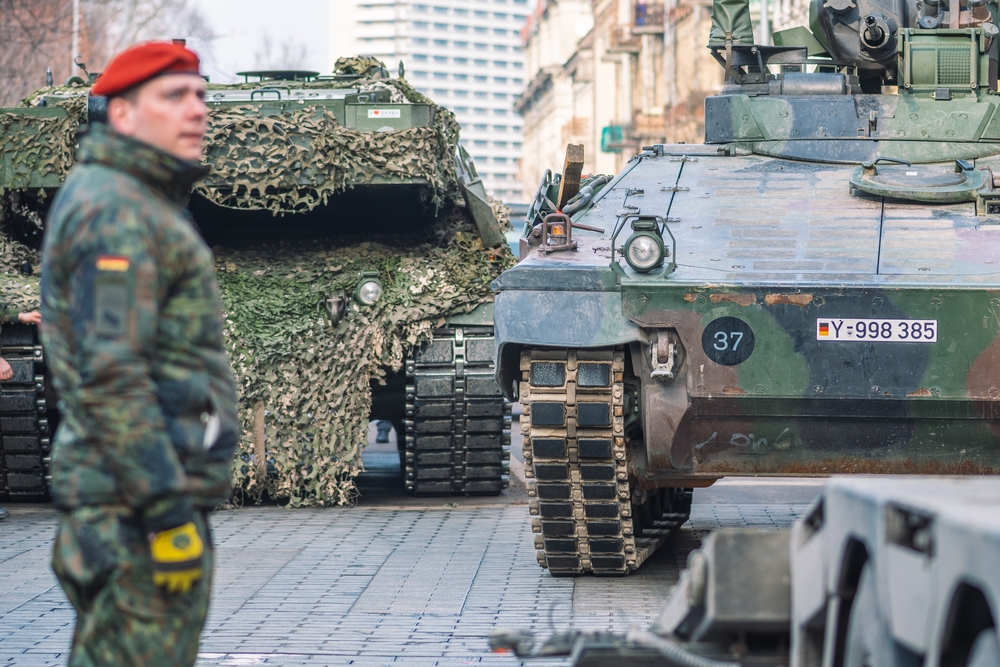
The fact that the world is entering a period of heightened geopolitical uncertainty is underscored by three recent signals. These include the widely reported U.S. intervention in Venezuela, rising tensions surrounding Greenland, and open discussions about the future of the transatlantic alliance. To this mix are added actions by European powers themselves—France and the United Kingdom have jointly declared the possible deployment of troops to Ukraine in the event of a peace agreement.
Budget Planning
From a financial perspective, the European Union is responding through the ReArm Europe initiative, whose total volume could ultimately reach up to EUR 800 billion. The primary objective is to push net military spending toward 2.5% of GDP, while in a broader security context, including cybersecurity, figures of up to 5% of GDP are being discussed. Importantly, this is not merely a short-term stimulus, but a long-term framework spread over several years to a decade. Funding sources are based on a combination of national budgets, European funds, and the increasingly active participation of private capital, which significantly enhances the stability of the overall investment story.
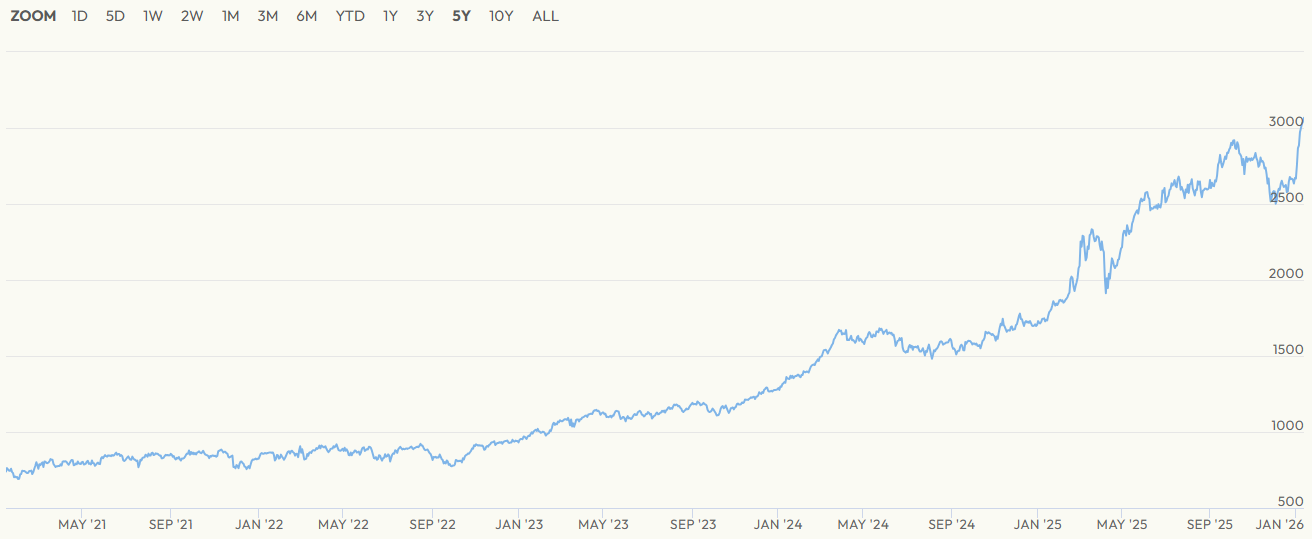
Price performance of the Europe Total Market Aerospace & Defense index over the past five years
Markets Respond
This shift in dynamics is also reflected in equity markets. European defense companies recorded strong growth already in 2025, specifically 56.5%, and added nearly 20% in the first weeks of 2026.* From an investment perspective, it is noteworthy that shares of companies such as Rheinmetall, Leonardo, Hensoldt, Renk, and Saab are currently trading at lower valuations relative to their U.S. counterparts, even though their growth and profitability outlooks are at least comparable.
Structural Inevitability
At the core of the European Union’s investment effort lies the need to make up for years of neglected defense innovation. Short-term priorities today include tanks, armored vehicles, and ammunition. From a longer-term perspective, however, the next phase will involve more complex and capital-intensive systems—air defense, missile technologies, fighter aircraft, and naval capabilities.
Investment Perspective
The European defense sector is transforming from a peripheral and often politically sensitive topic into a fully-fledged investment pillar. The combination of geopolitical risks, massive public budgets, the involvement of private capital, and still relatively attractive valuations of the companies involved creates a potentially strong and long-term investment trend for investors seeking portfolio diversification. [1]
* Data relating to the past are not a guarantee of future returns.
[1] Forward-looking statements represent assumptions and current expectations that may not be accurate or may be based on the current economic environment, which may change. These statements do not guarantee future performance. By their nature, forward-looking statements involve risks and uncertainties, as they relate to future events and circumstances that cannot be predicted, and actual developments and results may differ materially from those expressed or implied in any forward-looking statements.
Disclaimer! This marketing material is not and must not be understood as investment advice. Data relating to the past are not a guarantee of future returns. Investing in foreign currencies may affect returns due to exchange rate fluctuations. All securities transactions may result in both profits and losses. Forward-looking statements represent assumptions and current expectations that may not be accurate or may be based on the current economic environment, which may change. These statements do not guarantee future performance. InvestingFox is a trading brand of CAPITAL MARKETS, o.c.p., a.s., regulated by the National Bank of Slovakia.
Sources:
https://www.cnbc.com/2026/01/13/europe-defense-nato-greenland-crisis-venezuela-military-fuel-war-spending-invasion.html
https://www.cnbc.com/2026/01/09/nato-trump-greenland-war-invade-defense.html
https://www.cnbc.com/2026/01/07/us-venezuela-military-operation-maduro-injuries-casualties.html