 English

 Slovak
 Czech
Czech
 Hungarian
 Italian
 Polish
 Slovenian





Better results than the market expected
Revenue for the first quarter of fiscal year 2027 reached $1.67 billion, up 0.7% year-over-year. This exceeded analysts’ expectations of $1.65 billion. Adjusted earnings per share provided a more significant surprise, reaching $0.75 compared to the expected $0.59. This represents a beat of approximately 27%. However, this does not reflect year-over-year earnings growth but rather the difference from what the market had expected prior to the release of the results.1
Reported net income for the quarter ending August 30, 2026, fell from $64.3 million to $29.1 million. After adjustments, it reached $102.9 million, which is virtually the same level as a year ago. The difference is explained, among other things, by restructuring costs of $34.2 million and legal disputes or other claims totaling $33 million, both before taxes. However, the company also excludes stock-based compensation. Adjusted earnings should therefore not be confused with reported earnings, nor should all adjustments automatically be considered one-time items.1
North America is selling more and producing more efficiently
North America was the strongest performer, with revenue rising by approximately 5% to $1.14 billion. Sales volume increased by 7% thanks to new customers and larger orders from existing clients. Adjusted EBITDA, earnings before interest, taxes, and depreciation after additional adjustments, rose by 11% to $287.3 million. Cost savings and refunded tariffs totaling approximately $5 million contributed to this improvement. Therefore, not all of the increase can be attributed to sales alone.1
More efficient use of production capacity is also important. According to CEO Mike Smith, capacity utilization in North America increased by approximately 10 percentage points. Production adjustments are therefore expected to yield greater savings than management originally anticipated. With higher production volumes, fixed costs are spread across more products, which can improve profitability even without sharp revenue growth. This is significant for shareholders, as higher profits then do not have to depend solely on price increases.2 [2]
The international division remains under pressure
In the international division, revenue fell by 8% to $528.9 million, and adjusted EBITDA dropped by 54% to $26.5 million. Results were weighed down by weaker sales, particularly in Europe, higher potato costs from last year’s harvest, and underutilization of production facilities. Growth in the North American division was therefore insufficient to improve the group’s overall results. Its adjusted EBITDA fell year-over-year from $302.2 million to $285.6 million.1
Management has therefore halted production at the Broekhuizenvorst plant in the Netherlands and shifted order fulfillment to other facilities. In the Europe, Middle East, and Africa region, it aims to increase capacity utilization to over 90%. At the same time, however, it points to heat waves and drought, which have adversely affected the European potato harvest. The company is attempting to offset the expected rise in raw material costs by raising selling prices. The risk remains whether customers will accept these prices without further reducing their orders.3 [3]
Management raises full-year outlook
The company raised its outlook for adjusted earnings per share for fiscal year 2027 from a range of $2.95 to $3.25 to $3.05 to $3.35. It also improved its expected adjusted EBITDA, which is now projected to reach $1.125 billion to $1.215 billion, up from the original range of $1.10 billion to $1.20 billion. This is not a dramatic increase in the forecast, but after the first quarter, it is a clear signal that management expects a better full-year result than it had anticipated at the beginning of the year.1 [4]
Revenue is expected to grow by a low single-digit percentage, rather than remaining flat or growing by up to 1 percent as originally anticipated. The company is using a 52-week comparable basis to ensure that growth is not distorted by differences in the length of fiscal years. The outlook continues to project operating cash flow of $750 million to $800 million and capital expenditures of $380 million to $410 million. The essence of the expected improvement, therefore, is not sharp sales growth, but the ability to generate higher profits and cash flow amid moderate business growth.3 [5]
The stock market has welcomed the progress; the coming quarters will be decisive
Lamb Weston shares closed trading on October 6 up 7.49% at $47.91.* Investor interest was also confirmed by the volume of approximately 8.4 million shares traded, while the average over the previous 50 days was 1.6 million. Despite the significant daily gain, the price remained approximately 28.6% below its 52-week high. Thus, the positive reaction does not yet signal a return to previous price levels.4 [3]
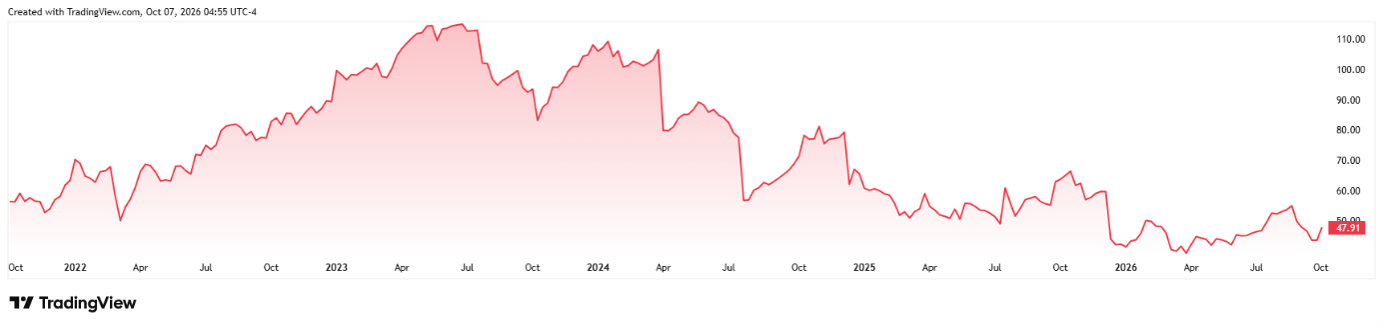
Lamb Weston’s stock price performance over the past five years*
It will now be important for shareholders to monitor the company’s ability to maintain profitability in North America, improve its international division, and reduce debt. The company generated approximately $144 million in free cash flow after capital expenditures during the quarter, but its net debt stood at approximately $3.8 billion. One strong quarter is therefore not enough to confirm a sustained turnaround. Lamb Weston must demonstrate that it can meet its higher outlook even amid rising input costs and without a further decline in international sales.3 [6]
Sources
[1,2,3,4,5,6] Forward-looking statements are based on assumptions and current expectations, which may be inaccurate, or on the current economic environment, which is subject to change. Such statements are not a guarantee of future performance. They involve risks and other uncertainties that are difficult to predict. Actual results may differ materially from those expressed or implied in any forward-looking statements.
* Past performance is no guarantee of future returns.
Warning! This marketing material is not and should not be construed as investment advice. Past performance is no guarantee of future returns. Investing in foreign currencies may affect returns due to fluctuations. All securities transactions may result in either gains or losses. Forward-looking statements represent assumptions and current expectations that may not be accurate or are based on the current economic environment, which is subject to change. These statements do not guarantee future performance. InvestingFox is a trademark of CAPITAL MARKETS, o.c.p., a.s., regulated by the National Bank of Slovakia.