
Back to blog

The New Nvidia and Intel Deal: What Investors Should Take Away!

The tech world was rocked by the news of a groundbreaking alliance between Nvidia, currently the most valuable company in the world, and Intel, the historically iconic chip manufacturer. From an investment perspective, this is a collaboration that has the potential to significantly strengthen the intrinsic value of both companies by expanding their product portfolios into highly promising areas.[1]

The New Nvidia and Intel Deal: What Investors Should Take Away!

Old Friendship, New Business

Behind the partnership are two visionaries who have known each other for three decades – Jensen Huang, CEO of Nvidia, and Lip-Bu Tan, CEO of Intel. Their shared vision was presented following more than a year of negotiations and is divided into two key project lines. Nvidia will become a major customer of Intel’s processors, with the goal of using them in complex artificial intelligence systems for data centers, employed for example by Microsoft.

On the other side, Intel will extensively utilize Nvidia-designed graphics processors in its chips for PCs and laptops, which Huang described as: “An underserved market.” The Nvidia CEO further stated that the value of the addressable markets for both sides of the collaboration is currently $50 billion.

Intel’s Financial Background

The product linkage of these giants also comes with Nvidia’s $5 billion investment into Intel’s common stock. However, it is essential to evaluate Intel’s longer-term situation as well. Over the past five years, the company has struggled with a loss of market value, since its local peak in 2020, Intel’s share price has fallen by more than 50%.*
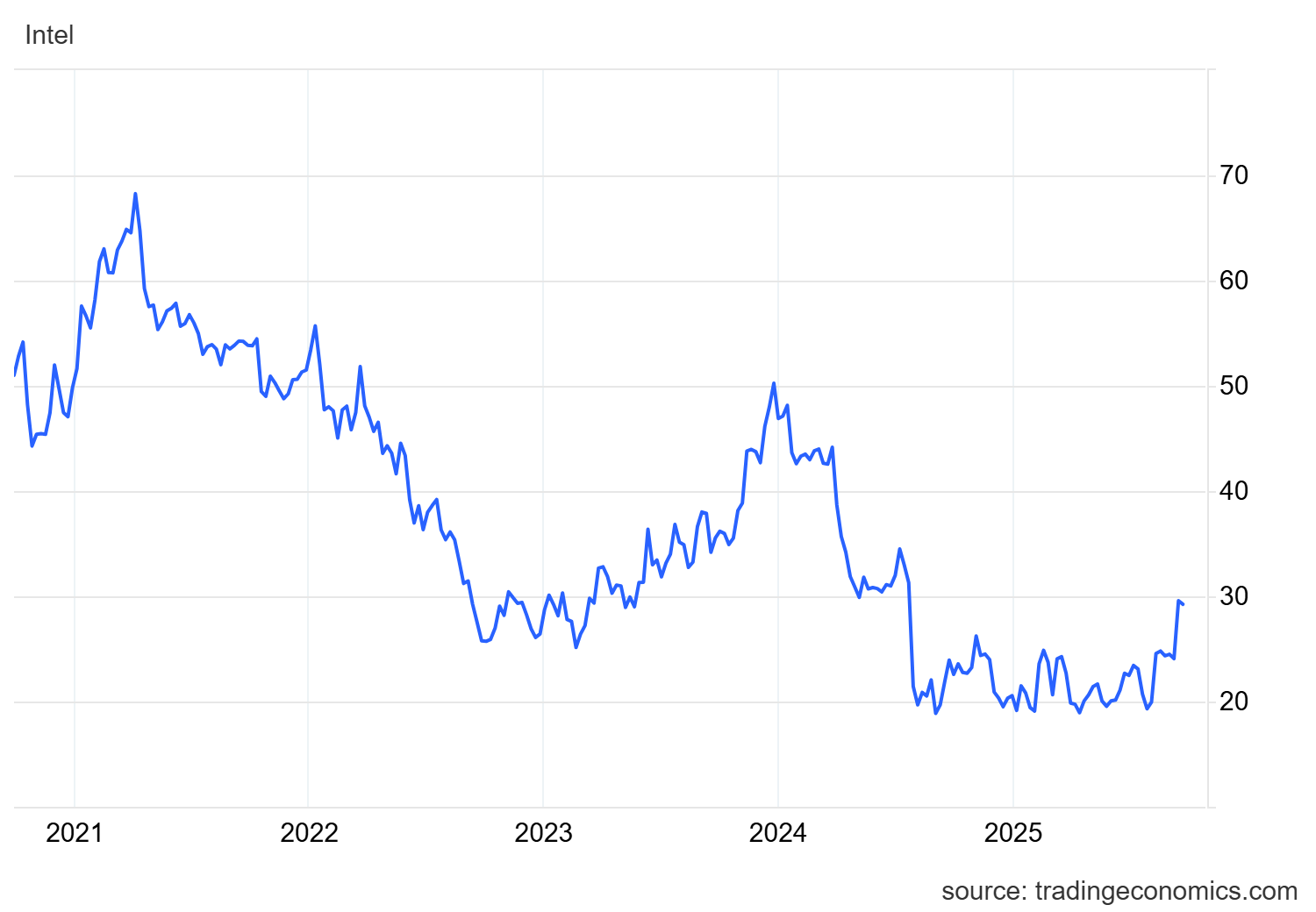
intc_us

Source: Trading Economics

Intel has been trying to handle the situation with several capital injections. The company received $8.9 billion from the U.S. government under the CHIPS Act program, in return for which Washington acquired a 10% stake. It also accepted an additional $2 billion from SoftBank, and by selling a majority stake in its ASIC subsidiary Altera, Intel collected $3.3 billion from Silver Lake.

Investors are also closely watching the future of Intel Foundry Services. Unfortunately, this division remains uncertain, without a major customer such as Nvidia or Apple, its ambitions will be difficult to fulfill. The United States, however, views Intel as a strategic company capable of producing the most advanced chips domestically.

Conclusion

The joint dynamic between Nvidia and Intel is full of contrasts. On one side stands a company with a market value exceeding $4 trillion, a symbol of the artificial intelligence era. On the other side is the well-known chipmaker seeking a path back to the top. For investors, this ultimately means that Intel is being given a second chance and may represent an interesting opportunity, while Nvidia further consolidates its position in the AI ecosystem. As is often the case in the market, however, success will depend on whether the grand plans can be turned into actual products and profits.[2]

*Past performance data is not a guarantee of future results.

[1,2] Forward-looking statements represent assumptions and current expectations, which may not be accurate, or are based on the current economic environment, which may change. These statements do not guarantee future performance. By their nature, forward-looking statements involve risk and uncertainty, as they relate to future events and circumstances that cannot be predicted, and actual developments and results may differ materially from those expressed or implied in any forward-looking statements.

Disclaimer! This marketing material is not and must not be understood as investment advice. Past performance data is not a guarantee of future results. Investments in foreign currencies may affect returns due to fluctuations. All securities transactions may result in both profits and losses. Forward-looking statements represent assumptions and current expectations, which may not be accurate, or are based on the current economic environment, which may change. These statements do not guarantee future performance. InvestingFox is a trade name of CAPITAL MARKETS, o.c.p., a.s., regulated by the National Bank of Slovakia.

Sources:

https://www.cnbc.com/2025/09/18/nvidias-huang-calls-5-billion-intel-stake-an-incredible-investment.html
https://nvidianews.nvidia.com/news/nvidia-and-intel-to-develop-ai-infrastructure-and-personal-computing-products
https://www.cnbc.com/2025/09/18/intel-nvidia-investment.html
https://www.cnbc.com/2025/08/18/intel-is-getting-a-2-billion-investment-from-softbank.html

InvestingFox is a trademark of CAPITAL MARKETS, o.c.p., a.s., with its registered office at Slávičie údolie 106, Bratislava – Staré Mesto district, 811 02. The company is registered in the Commercial Register of the Municipal Court Bratislava III, Section: Sa, File No.: 4295/B, ID No.: 36 853 054, VAT No.: 2022505419.

CAPITAL MARKETS, o.c.p., a.s. is a securities dealer pursuant to Section 55(1) of Act No. 566/2001 Coll. on Securities and Investment Services and on Amendments to Certain Acts, as amended (hereinafter the “Securities Act”). On October 30, 2007, CAPITAL MARKETS, o.c.p., a.s. was granted, by Decision No. OPK-2297/2007 of the National Bank of Slovakia -PLP, a license to provide investment services pursuant to Section 54(2) in conjunction with Sections 59(2) and (3) of the Securities Act, which was extended in accordance with the provisions of the Securities Act by Decision No. OPK-1830/2008-PLP dated April 21, 2008, Decision No. OPK-11601-1/2008 dated January 28, 2009, Decision No. ODT-5059-3/2012 dated July 23, 2012, and Decision No. ODT-9332/2014-1 dated October 21, 2014.

Read more

Lamb Weston Surprises the Stock Market: Profit Falls 55%, Shares Jump 7.5%

Lamb Weston Surprises the Stock Market: Profit Falls 55%, Shares Jump 7.5%

Frozen french fry manufacturer Lamb Weston announced its results on October 6, 2026, revealing a striking discrepancy between reported profits and the stock market’s reaction. Net income plummeted 55% year-over-year, yet investors responded by buying shares. The company exceeded expectations and raised its full-year outlook. Sales growth in North America and cost-cutting measures suggest that changes in the company’s operations are beginning to pay off. The question remains, however, whether this progress will be enough to resolve problems overseas. [1]

TD SYNNEX Far Exceeded Expectations: Revenue Jumped 38%, but Shares Fell After the Earnings Report

TD SYNNEX Far Exceeded Expectations: Revenue Jumped 38%, but Shares Fell After the Earnings Report

TD SYNNEX reported results that, at first glance, look very strong and confirm that the company is benefiting from growing demand for technology infrastructure. Upon closer inspection, however, the picture is not entirely clear-cut. Behind the record numbers lies a combination of rapid expansion, shifting margins, and significant cash flow fluctuations, which investors have begun to view with far greater sensitivity than revenue growth alone. It is precisely the difference between what the income statement shows and what is happening beneath the surface that makes TD SYNNEX’s latest quarter a much more interesting story than the headline numbers alone would suggest.

AutoZone Surprises Wall Street with Earnings: EPS Jumps 15%, but Weaker Sales Reveal Pressure on Customers

AutoZone Surprises Wall Street with Earnings: EPS Jumps 15%, but Weaker Sales Reveal Pressure on Customers

AutoZone closed fiscal year 2026 with results that appear very strong at first glance. Fourth-quarter revenue rose 5.6% year-over-year to $6.59 billion, net income increased to $931.6 million, and earnings per share reached $56.05, approximately 15% higher than a year ago and above Wall Street expectations. Beneath the surface, however, a weakness remains. Comparable sales growth fell short of forecasts, and American DIY car repairers continue to curb their purchases.1

Oracle Gains Momentum in AI: Cloud Revenue Grows 121%, Contracted Order Volume Reaches $664 Billion

Oracle Gains Momentum in AI: Cloud Revenue Grows 121%, Contracted Order Volume Reaches $664 Billion

Oracle kicked off the new fiscal year with results that once again confirmed that its transformation toward the cloud and artificial intelligence is gaining momentum. The company exceeded market expectations and demonstrated significant acceleration in the areas where it has directed the bulk of its investments in recent years. Behind the strong numbers, however, lies a question that will become increasingly important for investors. Oracle is growing rapidly, but the path to further expansion will be extremely costly. [1]