 English

 Slovak
 Czech
Czech
 Hungarian
 Italian
 Polish
 Slovenian




A strong player from Italy
The Italian company Leonardo is one of the largest manufacturers in the field of defence, security and space technologies in Europe. The company is known for its broad focus, and its dominance is especially visible in connection with the production of helicopters, radar systems and defense IT solutions. Thanks to its strong presence in NATO countries and an extensive product portfolio, Leonardo has a stable position in the market, and in addition, the current increased demand for modern sensors and combat systems significantly supports their growth. This is also reflected in the development of the share price, which increased by almost 100%1 from the beginning of 2025 to mid-March, which was also greatly helped by a year-on-year growth in sales of 11.1%.*
French technological backbone
Another promising technology company is Thales Group, which is not only active in the defense sector. The scope of the company, whose share price has similarly risen by more than 90%2, extends to aerospace, cyber security and civil solutions.* The company is characterized by a strong focus on the development of communication systems and the protection of critical infrastructure. Looking at the factors affecting stability and growth, it is crucial in this case to highlight French state contracts, which contributed to a year-on-year growth in consolidated net profit of 39%, as well as involvement in European Union projects.
German leader in ground technology
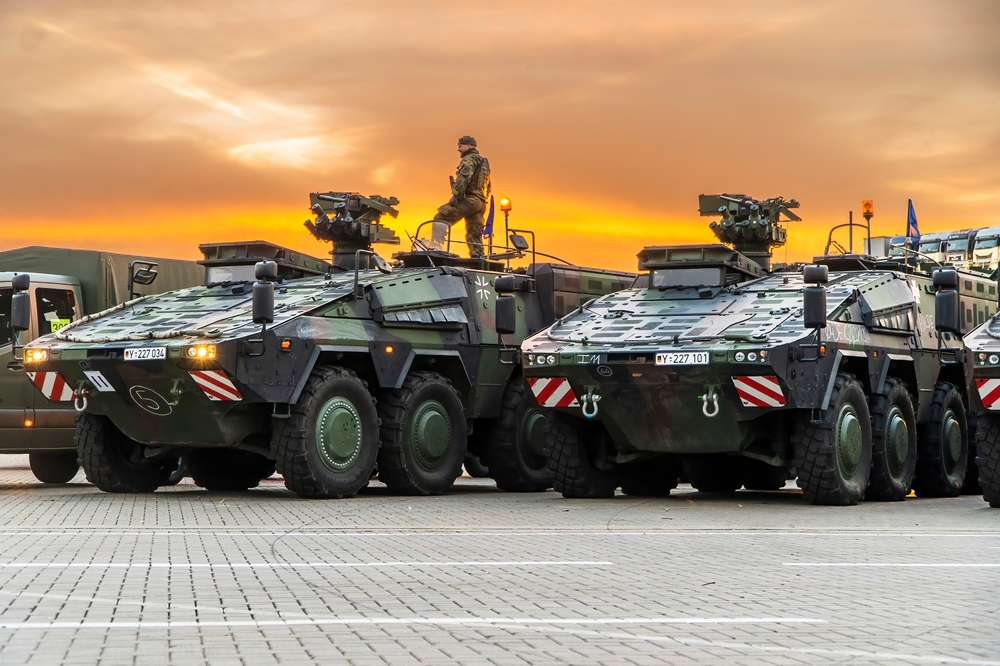
Rheinmetall, the largest manufacturer of ground equipment from Germany, specializes primarily in combat vehicles, artillery systems and ammunition. Recently, we have noticed the efforts of the German government to expand the armed forces, which of course plays into the hands of Rheinmetall. In connection with this, the share price increased by as much as 140%3 in the period under review from the beginning of the year to mid-March, along with a year-on-year growth in sales of 35%, thus surpassing the already solid growth of the competition.* If we were to evaluate this company, it is clearly a European leader in terms of production and development capacity.
The engine of French innovation
Given that diversification is essential, Safran acts as a leading supplier of aircraft engines, evacuation devices and specialized optical systems for military use. As it follows from the selection of previous companies, a strategic advantage in a certain area is absolutely necessary. Safran's strength lies in the fact that it works closely with GE on the production of engines for NATO aircraft. At the same time, however, it is also involved in the development of key defence technologies across the EU. Another advantage for the investor is that the share price is down about 20%4 from the absolute peak, while adjusted sales, reflecting the company's fundamental background, are growing by 17.8% year-on-year.*
British defense giant
The last on the list is the largest British defense company, BAE Systems, whose share price is growing by a more modest 50%5, but at the same time the demand for this company's solutions is growing by 32.4%.* The main business of this giant is the production of combat vehicles, related electronics, naval systems and military software. What is very important in this case is that the company maintains a close partnership with NATO, as well as with the USA. This reflects its stable income stream, which is usually reflected in the quarterly results, which to some extent affect the development of the price of their shares.
Conclusion
The defense sector as an investment anchor. These companies hold a key position in a balanced investment portfolio within the framework of sectoral diversification, and in the current market environment, they also provide protection against price declines of leading US technology companies. This, and inherently their financial performance, growing order volume and involvement in long-term strategic projects, make them attractive opportunities for investors looking for stability, long-term growth and portfolio diversification.
* Historical figures are not a guarantee of future returns.
Warning! This marketing material is not and should not be construed as investment advice. Data relating to the past are not a guarantee of future returns. Investing in foreign currency can affect returns due to fluctuations. All securities trades can lead to both profits and losses. Forward-looking statements represent assumptions and current expectations that may not be accurate or are based on the current economic environment, which is subject to change. These statements do not guarantee future performance. InvestingFox is a trademark of CAPITAL MARKETS, o.c.p., a.s., regulated by the National Bank of Slovakia.
1 Leonardo's share price performance over the past five years: * https://tradingeconomics.com/ldo:im
2 Thales Group's share price performance over the past five years: *https://tradingeconomics.com/ho:fp
3 Rheinmetall's share price performance over the past five years: * https://tradingeconomics.com/rhm:gr
4 Safran share price performance over the past five years: * https://tradingeconomics.com/saf:fp
5 BAE Systems stock price performance over the past five years: * https://tradingeconomics.com/ba:ln
Resources:
https://www.leonardo.com/en/business
https://www.thalesgroup.com/en/global/group#ourmarkets
https://www.rheinmetall.com/en/company/divisions/our-divisions