 English

 Slovak
 Czech
Czech
 Hungarian
 Italian
 Polish
 Slovenian





What exactly is Pershing Square proposing?
Pershing Square announced that it has submitted a non-binding offer to the board of directors of Universal Music Group to acquire all of the company’s shares through a merger with SPARC Holdings. Under the proposal, UMG shareholders would receive a total of €9.4 billion in cash, or €5.05 per share, along with 0.77 shares of the new company for each UMG share. The total package of cash and shares values UMG at €30.40 per share, representing a 78% premium over the last closing price of €17.10 prior to the proposal’s announcement. It is precisely this premium that makes it an aggressive yet very clear-cut offer, intended to convince the market that Ackman is aiming for a rapid turnaround in the story surrounding UMG shares.[1]
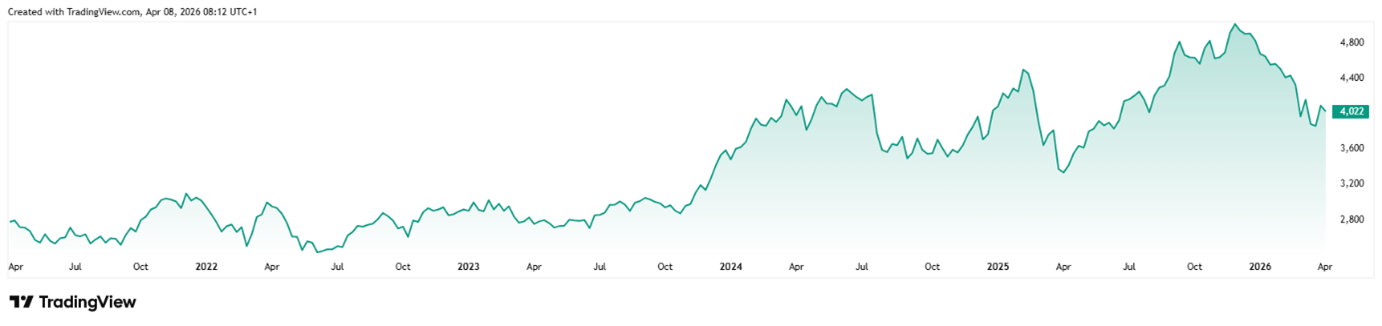
Pershing Square’s stock price performance over the past five years*
Why Ackman sees room for growth
The core of Ackman’s argument rests on the fact that, in his view, UMG’s music business itself is performing well, but the stock has long failed to reflect its true value. Pershing Square claims that the stock’s underperformance is primarily linked to uncertainty surrounding the Bolloré Group’s approximately 18% stake, the delay in the U.S. listing, an underutilized balance sheet, the lack of a clearly communicated capital allocation plan, and the fact that, according to the fund, the market does not sufficiently factor in the approximately €2.7 billion value of UMG’s stake in Spotify. Ackman also emphasized that the management team led by Lucian Grainge has done a very strong job in building the artist roster and in operational performance, yet the stock has still lagged due to factors not directly related to the operation of the music business.[2]
What the new company would look like
If the transaction goes through, UMG would merge with SPARC, and the newly formed company would become a Nevada corporation with a primary listing on the NYSE. Pershing Square claims that the new company would report results in accordance with U.S. accounting standards and would be eligible for inclusion in the S&P 500 and other indices, which is important because index visibility and greater liquidity often change the pool of stock buyers as well as the way the market values the stock. The plan also includes canceling 17% of existing shares while maintaining its investment-grade rating and long-term financial flexibility, with the new company expected to have 1.541 billion shares outstanding following the transaction. In other words, Ackman isn’t just selling a story about buying a music publisher, but a complete plan to rebuild UMG’s capital structure.[3]
Where are the main obstacles?
Despite the large figures, it is important to note that this is not yet a done deal, but rather a non-binding proposal that still requires approval from the boards of UMG and SPARC, the support of two-thirds of UMG shareholders present at the general meeting, and the necessary regulatory approvals. Reuters also reported that Universal Music did not immediately respond to a request for comment, indicating that the market has not yet received confirmation that the company’s management considers Ackman’s offer acceptable or even preferred. The broader context is also important. As recently as early March, UMG postponed its planned U.S. listing, citing market uncertainty and a valuation the company considered lower than its true value, so today’s proposal comes at a time when the question of entering the U.S. market remains sensitive and strategically open.1
What the market will be watching next
The coming days and weeks will determine whether Ackman can convince key shareholders that a U.S. listing and the new structure will deliver higher value per share than UMG’s independent path. The market will be watching, in particular, the stance of major shareholders, the sustainability of the offered premium, and whether investors’ views on UMG’s ability to manage capital and its valuation more actively will change.
Interestingly, just a few days before Ackman’s offer, Universal Music itself announced the launch of a €500 million share buyback program, which is set to run until October 1, 2026, at the latest, and under which the company may repurchase up to 50 million shares. The company stated that it would use the repurchased shares to fulfill obligations under the share program or to reduce its share capital, meaning that the issue of capital efficiency was already a priority at UMG before Pershing Square entered the picture. If Ackman now convinces the market that his solution is faster, larger, and more profitable for shareholders, this offer could become one of the most significant corporate events of the year in the European media sector.[4]
InvestingFox is a trademark of CAPITAL MARKETS, o.c.p., a.s., with its registered office at Slávičie údolie 106, Bratislava - Staré Mesto district 811 02. The company is registered in the Commercial Register of the Municipal Court Bratislava III, Section: Sa, File No.: 4295/B, ID No.: 36 853 054, VAT No.: 2022505419.
CAPITAL MARKETS, o.c.p., a.s. is a securities dealer pursuant to Section 55(1) of Act No. 566/2001 Coll. on Securities and Investment Services and on Amendments and Supplements to Certain Acts, as amended (hereinafter the “Securities Act”). On October 30, 2007, CAPITAL MARKETS, o.c.p., a.s. was granted, by Decision No. OPK-2297/2007 of the National Bank of Slovakia-PLP, a license to provide investment services within the meaning of Section 54(2) in conjunction with Sections 59(2) and (3) of the Securities Act, which was extended in accordance with the provisions of the Securities Act by Decision No. OPK-1830/2008-PLP dated April 21, 2008, Decision No. OPK-11601-1/2008 dated January 28, 2009, Decision No. ODT-5059-3/2012 dated July 23, 2012, and Decision No. ODT-9332/2014-1 dated October 21, 2014.
* Past performance is not a guarantee of future returns.
Warning! This marketing material is not and should not be construed as investment advice. Past performance is no guarantee of future results. Investing in foreign currencies may affect returns due to fluctuations. All securities transactions may result in both gains and losses. Forward-looking statements represent assumptions and current expectations that may not be accurate or are based on the current economic environment, which may change. These statements do not guarantee future performance. InvestingFox is a trademark of CAPITAL MARKETS, o.c.p., a.s., regulated by the National Bank of Slovakia.
[1]https://www.investing.com/news/stock-market-news/ackmans-pershing-square-offers-to-buy-universal-music-for-nearly-65-billion-4599680
[2]https://www.channelnewsasia.com/business/bill-ackmans-pershing-square-proposes-64-billion-merger-deal-universal-music-group-6040611
[3]https://www.businesswire.com/news/home/20260406138476/en/Pershing-Square-Announces-Proposal-to-Universal-Music-Group-N.V.
[4]https://www.universalmusic.com/universal-music-group-n-v-announces-start-of-its-share-buyback-program-of-e500-million/