 English

 Slovak
 Czech
Czech
 Hungarian
 Italian
 Polish
 Slovenian





In the past quarter, Dell not only met the expectations of analysts surveyed by the London Stock Exchange Group (LSEG) but exceeded them in many areas. Starting with earnings per share (EPS), it increased to 3.89 USD, significantly surpassing the market estimate of 3.53 USD. Similarly, revenues saw a positive development, increasing by nearly 40% year-on-year, reaching 33.38 billion USD, exceeding analysts’ consensus by over 1.5 billion USD.
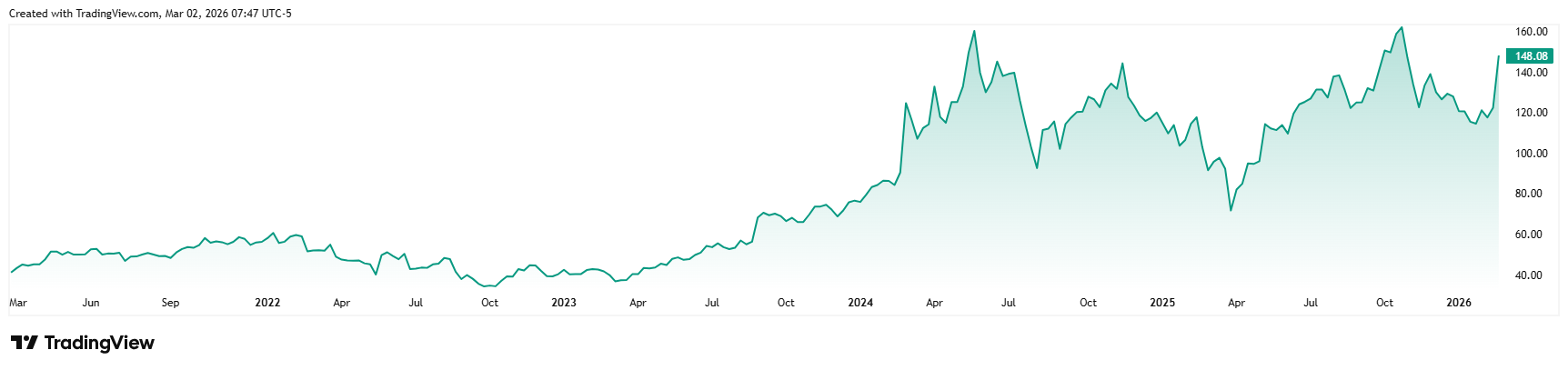
Performance of Dell’s stock price over the last five years
Dell’s fundamental strength for 2026 undoubtedly pleased investors, but the primary trigger for the subsequent stock price growth was the outlook for the upcoming fiscal year 2027. While the market had set the revenue forecast at just under 125 billion USD, Dell’s management confidently set the bar at 138 to 142 billion USD. This optimism stems primarily from the demand for AI servers, which are expected to generate 50 billion USD in revenue by 2027, more than double compared to the previous year. [1]
The Battle for Memory
The tech world is currently facing a historic shortage of memory chips, which is creating significant tension across the sector. Memory manufacturers are prioritizing high-bandwidth memory (HBM) components for chipmakers like Nvidia and AMD, or for cloud giants like Google. This leaves traditional hardware manufacturers with limited components, leading to longer delivery times and drastic price increases.
Dell has approached this crisis proactively and has already begun raising prices for its products in the past year. CFO David Kennedy clarified that these steps were necessary to offset higher costs and protect the company's margins. COO Jeff Clarke emphasized that the key to success lies in close collaboration with partners, which allows Dell flexibility in its supply chain, setting it apart from competitors who often struggle with unpreparedness for price shocks.
Market Divergence
Looking at the competitive environment, the contrast between the major players is striking. While Dell is growing based on fundamental parameters, HP’s stock has fallen to its 52-week low. * The primary problem for HP is that memory costs now account for approximately 35% of the total cost of manufacturing a computer, double what it was a year ago. The inability to pass on this 100% increase in costs to the end customer has unfortunately exposed the vulnerability of their business model.
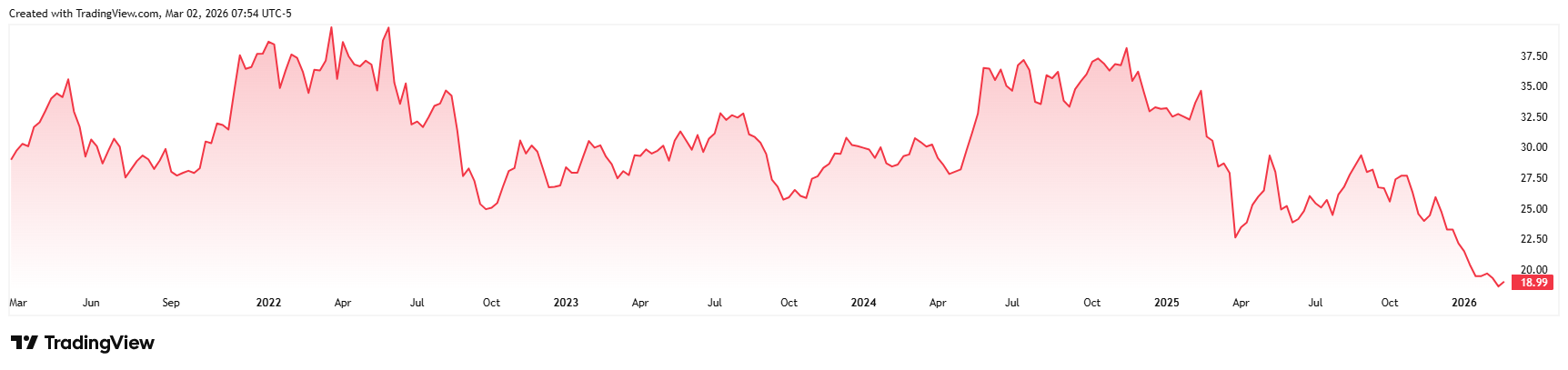
Performance of HP’s stock price over the last five years
Bank of America, while highlighting the risk of demand elasticity, or concerns that too-expensive computers may deter some customers, nonetheless raised its target price for Dell shares from 135 USD to 155 USD with a maintained "Buy" recommendation. [1] Unlike HP, Dell has successfully transformed its identity from a hardware vendor to a provider of comprehensive AI solutions, securing its place in institutional investors' portfolios.
Conclusion
If Dell succeeds in meeting its ambitious goal of doubling revenue from AI servers, it could become a fundamental pillar of infrastructure in the new digital era. Although questions remain about how long customers will be willing to accept rising hardware prices, the current dynamics clearly play in favor of this long-established Texas legend.
*Past performance is not a guarantee of future results.
[1] These statements do not guarantee future performance. Forward-looking statements inherently involve risks and uncertainties, as they relate to future events and circumstances that cannot be predicted, and actual developments and results may differ materially from those expressed or implied in any forward-looking statements.
Disclaimer! This marketing material is not and must not be construed as investment advice. Data related to the past are not a guarantee of future returns. Investing in foreign currency may affect returns due to fluctuations. All securities transactions may result in both gains and losses. Forward-looking statements represent assumptions and current expectations that may be inaccurate or based on the current economic environment, which may change. These statements do not guarantee future performance. InvestingFox is a trade name of CAPITAL MARKETS, o.c.p., a.s., regulated by the National Bank of Slovakia.
Sources:
https://investors.delltechnologies.com/
https://investors.delltechnologies.com/static-files/cbb4c668-2613-4d5c-a7dc-98fe4592b5a5
https://www.cnbc.com/2026/02/27/dell-stock-earnings-memory-shortage-ai-servers.html