Back to blog

European Defense Strategy as a Renewed Investment Pillar

Defense spending in the European Union has definitively shifted in recent years from the margins of political and investment interest to the center of attention. A combination of persistent geopolitical threats, the armed conflict in Ukraine, growing doubts about the long-term security commitments of the United States toward NATO, and a historical investment deficit is creating an environment in which Europe has no alternative but to significantly strengthen its own defense capabilities. Which companies are likely to benefit the most? European Defense Strategy as a Renewed Investment Pillar
Geopolitics

The fact that the world is entering a period of heightened geopolitical uncertainty is underscored by three recent signals. These include the widely reported U.S. intervention in Venezuela, rising tensions surrounding Greenland, and open discussions about the future of the transatlantic alliance. To this mix are added actions by European powers themselves—France and the United Kingdom have jointly declared the possible deployment of troops to Ukraine in the event of a peace agreement.

Budget Planning

From a financial perspective, the European Union is responding through the ReArm Europe initiative, whose total volume could ultimately reach up to EUR 800 billion. The primary objective is to push net military spending toward 2.5% of GDP, while in a broader security context, including cybersecurity, figures of up to 5% of GDP are being discussed. Importantly, this is not merely a short-term stimulus, but a long-term framework spread over several years to a decade. Funding sources are based on a combination of national budgets, European funds, and the increasingly active participation of private capital, which significantly enhances the stability of the overall investment story.
Výstřižek

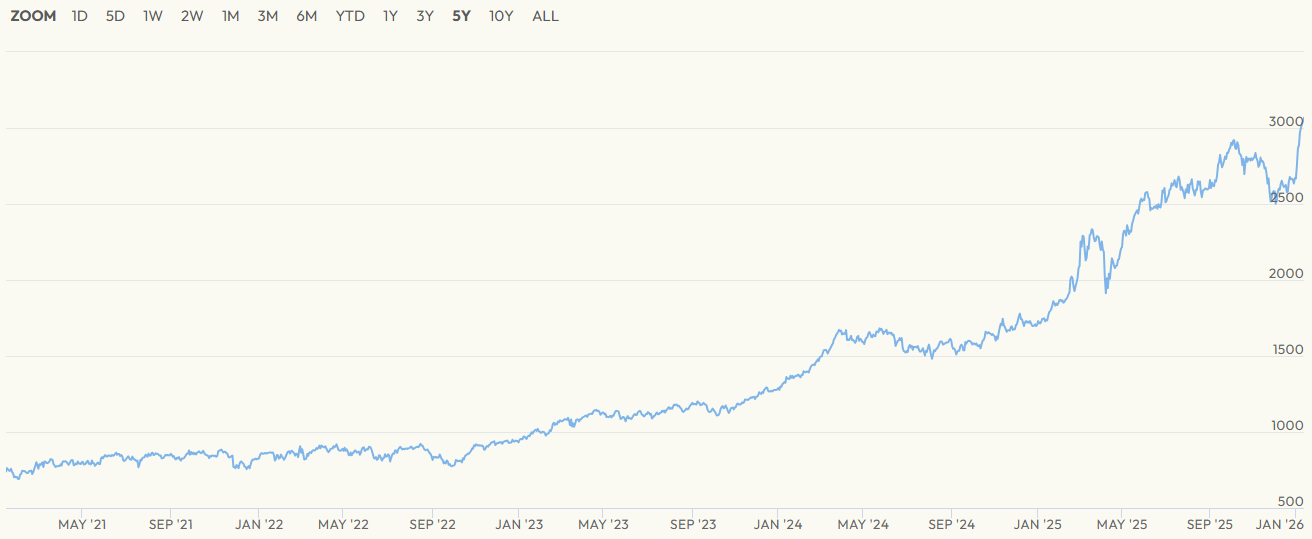
Price performance of the Europe Total Market Aerospace & Defense index over the past five years

Markets Respond

This shift in dynamics is also reflected in equity markets. European defense companies recorded strong growth already in 2025, specifically 56.5%, and added nearly 20% in the first weeks of 2026.* From an investment perspective, it is noteworthy that shares of companies such as Rheinmetall, Leonardo, Hensoldt, Renk, and Saab are currently trading at lower valuations relative to their U.S. counterparts, even though their growth and profitability outlooks are at least comparable.

Structural Inevitability

At the core of the European Union’s investment effort lies the need to make up for years of neglected defense innovation. Short-term priorities today include tanks, armored vehicles, and ammunition. From a longer-term perspective, however, the next phase will involve more complex and capital-intensive systems—air defense, missile technologies, fighter aircraft, and naval capabilities.

Investment Perspective

The European defense sector is transforming from a peripheral and often politically sensitive topic into a fully-fledged investment pillar. The combination of geopolitical risks, massive public budgets, the involvement of private capital, and still relatively attractive valuations of the companies involved creates a potentially strong and long-term investment trend for investors seeking portfolio diversification. [1]

* Data relating to the past are not a guarantee of future returns.

[1] Forward-looking statements represent assumptions and current expectations that may not be accurate or may be based on the current economic environment, which may change. These statements do not guarantee future performance. By their nature, forward-looking statements involve risks and uncertainties, as they relate to future events and circumstances that cannot be predicted, and actual developments and results may differ materially from those expressed or implied in any forward-looking statements.

Disclaimer! This marketing material is not and must not be understood as investment advice. Data relating to the past are not a guarantee of future returns. Investing in foreign currencies may affect returns due to exchange rate fluctuations. All securities transactions may result in both profits and losses. Forward-looking statements represent assumptions and current expectations that may not be accurate or may be based on the current economic environment, which may change. These statements do not guarantee future performance. InvestingFox is a trading brand of CAPITAL MARKETS, o.c.p., a.s., regulated by the National Bank of Slovakia.

Sources:

https://www.cnbc.com/2026/01/13/europe-defense-nato-greenland-crisis-venezuela-military-fuel-war-spending-invasion.html
https://www.cnbc.com/2026/01/09/nato-trump-greenland-war-invade-defense.html
https://www.cnbc.com/2026/01/07/us-venezuela-military-operation-maduro-injuries-casualties.html


InvestingFox is a trademark of CAPITAL MARKETS, o.c.p., a.s., with its registered office at Slávičie údolie 106, Bratislava – Staré Mesto district, 811 02. The company is registered in the Commercial Register of the Municipal Court Bratislava III, Section: Sa, File No.: 4295/B, ID No.: 36 853 054, VAT No.: 2022505419.

CAPITAL MARKETS, o.c.p., a.s. is a securities dealer pursuant to Section 55(1) of Act No. 566/2001 Coll. on Securities and Investment Services and on Amendments to Certain Acts, as amended (hereinafter the “Securities Act”). On October 30, 2007, CAPITAL MARKETS, o.c.p., a.s. was granted, by Decision No. OPK-2297/2007 of the National Bank of Slovakia -PLP, a license to provide investment services pursuant to Section 54(2) in conjunction with Sections 59(2) and (3) of the Securities Act, which was extended in accordance with the provisions of the Securities Act by Decision No. OPK-1830/2008-PLP dated April 21, 2008, Decision No. OPK-11601-1/2008 dated January 28, 2009, Decision No. ODT-5059-3/2012 dated July 23, 2012, and Decision No. ODT-9332/2014-1 dated October 21, 2014.

Read more

JPMorgan Chase Disappoints Wall Street: Even a Profit of $15.3 Billion Fell Short of Expectations

JPMorgan Chase Disappoints Wall Street: Even a Profit of $15.3 Billion Fell Short of Expectations

JPMorgan Chase zveřejnil 13. října výsledky za třetí čtvrtletí roku 2026, které pro Wall Street znamenaly neobvyklé zklamání. Největší americká banka vykázala zisk 5,57 USD na akcii oproti odhadu 5,85 USD a podle údajů LSEG poprvé od posledního čtvrtletí roku 2023 nesplnila prognózy zisku. Slabší výnosy z dluhopisových trhů a zpomalení investičního bankovnictví ukázaly, kde naráží její růst na omezení. Pro investory je nyní zásadní, zda banka dokáže udržet růst výnosů a zároveň zvládnout rostoucí náklady.1

Lamb Weston Surprises the Stock Market: Profit Falls 55%, Shares Jump 7.5%

Lamb Weston Surprises the Stock Market: Profit Falls 55%, Shares Jump 7.5%

Frozen french fry manufacturer Lamb Weston announced its results on October 6, 2026, revealing a striking discrepancy between reported profits and the stock market’s reaction. Net income plummeted 55% year-over-year, yet investors responded by buying shares. The company exceeded expectations and raised its full-year outlook. Sales growth in North America and cost-cutting measures suggest that changes in the company’s operations are beginning to pay off. The question remains, however, whether this progress will be enough to resolve problems overseas. [1]

TD SYNNEX Far Exceeded Expectations: Revenue Jumped 38%, but Shares Fell After the Earnings Report

TD SYNNEX Far Exceeded Expectations: Revenue Jumped 38%, but Shares Fell After the Earnings Report

TD SYNNEX reported results that, at first glance, look very strong and confirm that the company is benefiting from growing demand for technology infrastructure. Upon closer inspection, however, the picture is not entirely clear-cut. Behind the record numbers lies a combination of rapid expansion, shifting margins, and significant cash flow fluctuations, which investors have begun to view with far greater sensitivity than revenue growth alone. It is precisely the difference between what the income statement shows and what is happening beneath the surface that makes TD SYNNEX’s latest quarter a much more interesting story than the headline numbers alone would suggest.

AutoZone Surprises Wall Street with Earnings: EPS Jumps 15%, but Weaker Sales Reveal Pressure on Customers

AutoZone Surprises Wall Street with Earnings: EPS Jumps 15%, but Weaker Sales Reveal Pressure on Customers

AutoZone closed fiscal year 2026 with results that appear very strong at first glance. Fourth-quarter revenue rose 5.6% year-over-year to $6.59 billion, net income increased to $931.6 million, and earnings per share reached $56.05, approximately 15% higher than a year ago and above Wall Street expectations. Beneath the surface, however, a weakness remains. Comparable sales growth fell short of forecasts, and American DIY car repairers continue to curb their purchases.1