 English

 Slovak
 Czech
Czech
 Hungarian
 Italian
 Polish
 Slovenian






Revenue and Profit Growth
In the third quarter of fiscal year 2026, Accenture reported revenue of $18.7 billion, representing year-over-year growth of 6% in U.S. dollars and 3% in local currencies; however, this also represented a shortfall of approximately $80 million compared to Wall Street’s consensus estimates. Earnings per share rose 9% to $3.80*, slightly exceeding market expectations, while net income increased to approximately $2.39 billion from about $2.24 billion in the same quarter last year.1
The operating margin reached 17% and widened by 20 basis points year-over-year; combined with 6% revenue growth, this indicates that Accenture was able to scale its revenue while simultaneously improving efficiency. Free cash flow for the quarter reached $3.6 billion, and for the first nine months of the fiscal year, the company generated revenue of $55.5 billion, with 7% growth in U.S. dollars and 4% growth in local currencies, underscoring the robustness of the business even amid slowing IT spending.[1]
Segments and Regions
The revenue breakdown shows that growth remains broadly diversified, although the pace varies across segments and regions. Total new orders reached $19.3 billion, a slight decline from $19.7 billion in the third quarter of fiscal year 2025, indicating that demand for large-scale transformation projects remains strong but is less explosive than in the past. Within its portfolio, growth continues in the areas of cloud, data analytics, AI, and cybersecurity, while Accenture also strengthened its acquisition pipeline in the OT cybersecurity sector quarter-over-quarter through companies such as Dragos, runZero, and NetRise, which is expected to support further organic growth in critical infrastructure.2
From a geographic perspective, the company reports continued growth in North America and in parts of the European markets, but also acknowledges weaker performance in the U.S. at the federal level, where a reduction in contracts is lowering this segment’s overall contribution to revenue. Overall, Accenture confirms that it continues to gain market share across key markets, though the pace of expansion is more selective and depends on specific technology segments and clients’ willingness to launch large-scale transformation programs.[2]
Margins, Cash Flow, and Returns to Shareholders
One of the strongest aspects of the results is margins and the ability to generate cash, which is a key selling point for investors seeking a stable return on capital. Operating profit for the quarter reached approximately $3.18 billion, representing 6% growth and confirming that the company can maintain high profitability even at a more moderate pace of revenue growth. Free cash flow of $3.6 billion in the third quarter and $8.8 billion since the start of the fiscal year indicates a very strong conversion of earnings into cash, with management expecting full-year free cash flow to range from $10.8 billion to $11.5 billion, which is approximately $1 billion more than in the previous year.2
Based on this cash generation, Accenture returned $2.2 billion to shareholders in the third quarter through $1.2 billion in share repurchases and $1.0 billion in dividends, with the quarterly dividend per share reaching $1.63, a 10% increase year-over-year. Management also expects to return at least $9.5 billion to shareholders for the full fiscal year 2026, underscoring that capital discipline and shareholder returns remain key pillars of Accenture’s investment story.2 [1]
Outlook
The updated outlook provided by Accenture reflects a combination of cautious revenue growth and an ambitious plan to continue improving profitability and cash flow. The company now expects full-year revenue growth in the range of 3% to 4% in local currencies; after adjusting for an approximately 1% negative impact from the U.S. federal government business, growth is expected to reach 4% to 5%, which represents a slight narrowing and refinement compared to the previous outlook of 2% to 5%. In terms of profitability, Accenture expects full-year GAAP earnings per share to be in the range of $13.38 to $13.50, representing 10 to 11% growth, while adjusted EPS is expected to range from $13.78 to $13.90, representing growth of 7 to 8 percent, and the adjusted operating margin is expected to increase by 20 basis points year-over-year to 15.8 percent.3
For the fourth quarter, the company expects revenue in the range of $17.75 to $18.4 billion, which—taking into account a negative foreign exchange impact of approximately half a percent—translates to organic growth in the range of 1 to 5 percent; this is a rather conservative projection that reflects clients’ caution regarding new projects. This mix of moderate growth and continued margin expansion paints a picture of a company that prioritizes efficiency and cash flow, yet must also contend with the fact that demand momentum is no longer as strong as it was during the peak of the post-pandemic digitalization wave.3 [2]
Market Reaction and What Investors Can Take Away
Although the results objectively show revenue growth, margin expansion, strong cash flow, and a higher earnings-per-share outlook, the market reacted very harshly to the third-quarter report. Accenture’s stock fell nearly 18% following the earnings release and closed around $127.98, which is significantly below the average share buyback price for the quarter of approximately $198.84, signaling a sharp reassessment of expectations by investors.* The main reasons for the nervousness are revenue that fell slightly short of the consensus by approximately $80 million, a 2% decline in new orders in dollar terms, and the fact that some large managed services contracts were deferred to future periods, which increases uncertainty regarding the short-term demand trend.
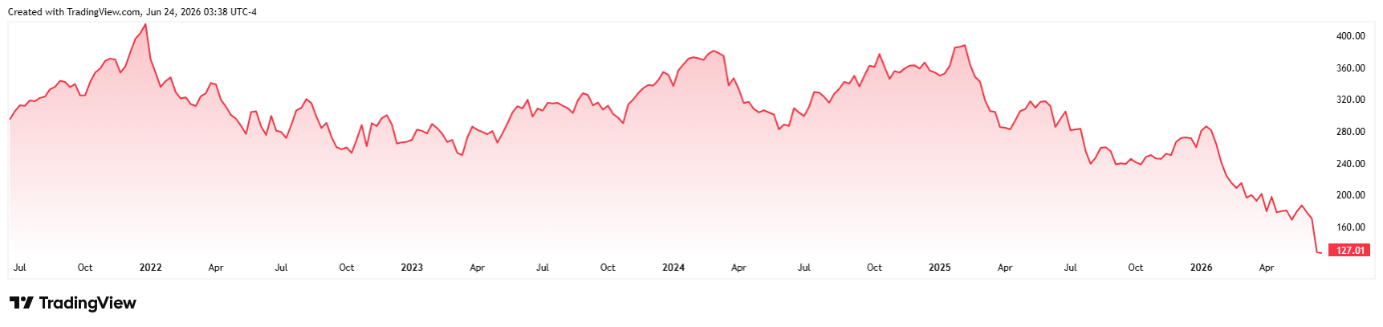
Accenture’s stock price performance over the past five years*
For investors, this reaction signals that, for companies like Accenture, the market evaluates not only the numbers themselves but, above all, the growth trajectory, the strength of the order flow, and whether management can convincingly demonstrate that the current slowdown is cyclical rather than structural. From a longer-term perspective, however, the current price decline, in the context of continued EPS growth, stable margins, and high free cash flow, creates room for discussion as to whether Accenture is becoming a case where short-term market fears are opening up an attractive entry point for more patient investors who believe in the continuation of the trend toward digital transformation and AI investments in large enterprises. [3]
* Past performance is no guarantee of future returns.
[1,2,3] Forward-looking statements are based on assumptions and current expectations, which may be inaccurate, or on the current economic environment, which is subject to change. Such statements are not a guarantee of future performance. They involve risks and other uncertainties that are difficult to predict. Actual results may differ materially from those expressed or implied in any forward-looking statements.
Warning! This marketing material is not and should not be construed as investment advice. Past performance is no guarantee of future returns. Investing in foreign currencies may affect returns due to fluctuations. All securities transactions may result in either gains or losses. Forward-looking statements represent assumptions and current expectations that may not be accurate or are based on the current economic environment, which is subject to change. These statements do not guarantee future performance. InvestingFox is a trademark of CAPITAL MARKETS, o.c.p., a.s., regulated by the National Bank of Slovakia.
[1] https://newsroom.accenture.com/content/3qfy26-earnings/accenture-reports-third-quarter-fiscal-2026-results.pdf
[2] https://www.investing.com/news/company-news/accenture-q3-fy26-slides-margin-gains-offset-by-revenue-miss-stock-plunges-93CH-4751654