 English

 Slovak
 Czech
Czech
 Hungarian
 Italian
 Polish
 Slovenian





For the first quarter of fiscal year 2026, which ended on May 3, 2026, Lululemon reported net revenue of $2.4716 billion, representing year-over-year growth of 4% compared to $2.037 billion in the same period last year. In constant currency, revenue grew at a rate of 2%, which management views as a slowdown compared to previous years, when the company typically achieved double-digit growth. Comparable sales, i.e., sales on a comparable store and e-shop basis, rose by 1%, but fell by 2% in constant currencies, confirming that there is noticeable pressure beneath the surface of total sales.[1]
The picture is significantly weaker when it comes to profitability. Gross profit decreased by 3% year-over-year to $1.339 billion, and the gross margin fell by 410 basis points to 54.2%, with the main factors being higher discount costs, an unfavorable product mix, and cost pressures in the supply chain. Operating profit plummeted by 37% to $276.9 million, and the operating margin fell to 11.2%, which is a very significant change for a company accustomed to substantially higher margins. Net income reached $195 million, and diluted earnings per share were $1.69 compared to $2.60 last year, representing a decline of approximately 35%.*1
U.S. sales are down, but international growth is holding steady
Regional figures confirm that the problem is primarily domestic. Sales in the Americas region fell by 3% year-over-year and by as much as 4% in constant currency, a sharp contrast to last year, when North America was driving the entire company. Comparable revenue in the Americas decreased by 5% and by 6% in constant currency, indicating that the pressure stems not only from exchange rates but also from demand itself and customers’ price elasticity.1
Conversely, the international segment remains a clear bright spot in the results. Sales outside the Americas region rose by 22% year-over-year and by 16% in constant currencies, with comparable sales growing by 13% and 8%, respectively. China is particularly strong; according to the earnings commentary and earnings call, revenue in mainland China grew by approximately 30% or 23% in constant currencies, making Lululemon a still highly relevant player in the premium activewear segment in this region. This asymmetry between weaker performance in North America and strong growth internationally is key to interpreting the results and suggests that the issue is more region-specific than purely product-related.1
Revenue of 11 to 11.15 billion and a weaker year ahead for the company
The strongest signal came from the outlook the company expects for the remainder of fiscal year 2026. Lululemon now expects full-year net revenue in the range of $11.0 to $11.15 billion, which represents a change from the previous forecast and implies year-over-year growth ranging from minus 1% to approximately zero. Earlier this year, the company had anticipated a higher figure, but the current outlook reflects weaker performance in North America, discussions surrounding the brand on social media, and new product launches that, according to management, failed to fully capture consumer demand in the U.S.1 [1]
Lululemon also expects full-year diluted earnings per share in the range of $10.95 to $11.15, which is below the level the market had originally anticipated and reflects lower margins as well as higher investments in product restructuring and marketing. Looking ahead to the next quarter, the outlook is even more straightforward. For the second quarter of fiscal year 2026, the company expects revenue between $2.450 billion and $2.475 billion, representing a year-over-year decline of 3% to 2%, and diluted earnings per share between $1.76 and $1.81 at an estimated effective tax rate of approximately 30%. For investors, this is a clear signal that management is not trying to downplay the situation in the short term, but is openly acknowledging a weaker year in which it will have to invest more to kickstart the brand’s growth again.1 [2]
Why did the stock react with a double-digit drop
The market did not interpret these results as a normal quarterly slowdown, but as a combination of three unfavorable factors. First, earnings per share fell from $2.60 a year ago to $1.69, a decline of approximately 35%*, and the operating margin narrowed to 11.2%, a year-over-year decline of 580 basis points. Second, although revenue grew overall, the U.S. segment, which remains the key market, saw a decline in both revenue and comparable sales, leaving investors uncertain whether this is merely a short-term blip within the cycle. Third, the reduction of the full-year revenue outlook to $11 to $11.15 billion and lower expected EPS sent a signal that management itself expects a weaker year and that a turnaround will not come immediately.1 [3]
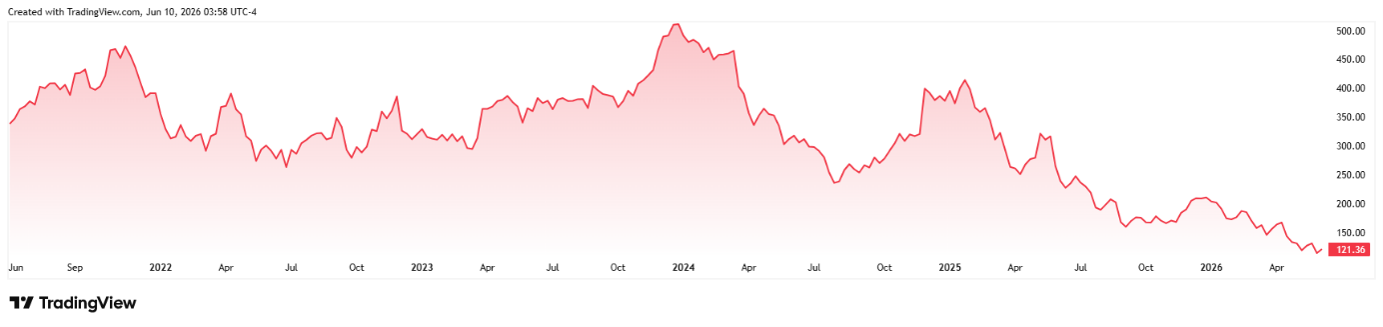
Lululemon’s stock price performance over the past five years*
The market reaction was swift and sharp. Shortly after the results were released, Lululemon shares fell by approximately 11% to 14% as investors priced in lower growth, lower margins, and greater uncertainty surrounding U.S. demand, as well as how quickly the planned product and marketing adjustments would take effect.* With a market capitalization in the tens of billions of dollars, such a one-day move represents a loss of billions in market value and, at the same time, a shift in valuation toward lower earnings multiples that better reflect the new trajectory of expected growth. For a long-term investor, it is important that the market immediately prices in a significant portion of this negative change, which raises the question of whether the reaction is adequate or excessive.
What will determine whether the decline is an opportunity or the start of a new phase
Both the official report and management comments indicate that Lululemon does not intend to respond merely by cutting costs, but rather through adjustments to its product portfolio and brand restructuring in North America. The company notes that in the U.S., it faced negative discussions about the brand on social media, and some new product launches failed to deliver the expected sales boost, leading to changes in collection planning and marketing communications. At the same time, it emphasizes that international growth, particularly in China, confirms the brand’s strength and the long-term potential for global expansion, so this is not a widespread weakening of the brand but a regional issue that needs to be addressed.[2]
Three areas will be decisive for the market in the coming quarters. First, whether comparable sales in the Americas can be stabilized, ideally toward zero or slightly positive growth, which would indicate that product and marketing interventions are working. Second, whether the company can maintain double-digit international growth, which is key to ensuring that overall net sales growth does not remain in the zero-growth range for the long term. And third, whether it can halt the decline in margins and gradually return them to historical levels, even if that comes at the expense of short-term growth. If Lululemon manages to accomplish these three tasks, today’s decline may look in hindsight like an overly harsh punishment for a single weaker year. If not, it will likely mark a turning point, after which the market will begin to perceive the brand as a less growth-oriented and more cyclical retail company.[4]
[1,2,3,4] Forward-looking statements are based on assumptions and current expectations, which may be inaccurate, or on the current economic environment, which may change. Such statements are not guarantees of future performance. They involve risks and other uncertainties that are difficult to predict. Actual results may differ materially from those expressed or implied in any forward-looking statements.
* Past performance is no guarantee of future returns.
Warning! This marketing material is not and should not be construed as investment advice. Past performance is no guarantee of future results. Investing in foreign currencies may affect returns due to exchange rate fluctuations. All securities transactions may result in both gains and losses. Forward-looking statements represent assumptions and current expectations that may not be accurate or are based on the current economic environment, which is subject to change. These statements do not guarantee future performance. InvestingFox is a trademark of CAPITAL MARKETS, o.c.p., a.s., regulated by the National Bank of Slovakia.
InvestingFox is a trademark of CAPITAL MARKETS, o.c.p., a.s., with its registered office at Slávičie údolie 106, Bratislava – Staré Mesto district 811 02. The company is registered in the Commercial Register of the Municipal Court Bratislava III, Section: Sa, File No.: 4295/B, ID No.: 36 853 054, VAT No.: 2022505419.
CAPITAL MARKETS, o.c.p., a.s. is a securities dealer pursuant to Section 55(1) of Act No. 566/2001 Coll. on Securities and Investment Services and on Amendments to Certain Acts, as amended (hereinafter the “Securities Act”). On October 30, 2007, CAPITAL MARKETS, o.c.p., a.s. was granted, by Decision No. OPK-2297/2007 of the National Bank of Slovakia-PLP, a license to provide investment services pursuant to Section 54(2) in conjunction with Sections 59(2) and (3) of the Securities Act, which was extended in accordance with the provisions of the Securities Act by Decision No. OPK-1830/2008-PLP dated April 21, 2008, Decision No. OPK-11601-1/2008 dated January 28, 2009, Decision No. ODT-5059-3/2012 dated July 23, 2012, and Decision No. ODT-9332/2014-1 dated October 21, 2014.
[1] https://corporate.lululemon.com/media/press-releases/2026/06-04-2026-210523775
[2] https://www.investing.com/news/transcripts/earnings-call-transcript-lululemon-q1-2026-sees-revenue-rise-stock-gains-93CH-4727636